So the 2023 Rugby World Cup has been decided in Paris by one point between two giants of the rugby world in South Africa and New Zealand. As the rain came down at Saint-Denis the Springboks went about their business of acquiring points through the boot of Handre Pollard to be up 12-6 at half-time. The only points in the second half was an unconverted try by Beauden Barrett that left the All Blacks one short at the end to lose by the slimmest of margins, 11-12.
After seven weeks of intense battle, the two teams that had each won the tournament three times a piece, were left to fight the final battle. The Northern Hemisphere had said that the Southern Hemisphere were not up to standard, but some performances of Fiji and Argentina, in particular, were worth taking note of. Despite this, Australia performed badly losing to Fiji for the first time in 69 years and being thumped by Wales 40-6 in the Pool stages which meant they could not reach the knockout stages for the first time in World Cup history. A lot of the blame can be laid on the coach, Eddie Jones, for not preparing his young team to do better. As a consequence, he has resigned from his position.
However, the final came down to two teams that had lost one match each in their respective Pool matches. New Zealand lost to France, 13-27, and South Africa lost to Ireland, 8-13. Ironically, those matches were reversed in the quarter-finals where New Zealand defeated Ireland, 28-24, and South Africa defeated France, 29-28. While the All Blacks had an easy route over Los Pumas, 44-6, in the semi-final the Springboks did it much harder against a determined English side to win by a single point, 16-15.
It is a true testament that the Springbok team could galvanise under Siya Kolisi to win a fourth Webb-Ellis trophy, back-to-back champions. And not just the team as Kolisi says, “Our country goes through such a lot and we are that very hope that they have”. They had plenty of support in the crowd as well, none more so than tennis great Roger Federer whose mother is South African. Well done!
The ancient Roman city of Lugdunum (modern day Lyon) was where the Australian Wallabies met their Waterloo. And just as many martyrs have died in the various colisseums scattered throughout the city, the wounded Wallabies join this pile. Coming into the match against Wales they had suffered their first defeat in 69 years, 15-22, at the hands of their South Pacific cousins, Fiji. Being put to the sword with a 40-6 thumping by the Welsh, Australian rugby is at an all-time low and staring down the possibility of not getting out of their Pool for the first time in World Cup history.
The recriminations against their coach, the talismanic Eddie Jones, have already began with quarter-final positions not yet decided. If he did take a call from the Japanese Rugby Football Union (JRFU), to which he strongly denied, before the World Cup then the distractions before the important Wales match can be justified; if not then a really bad look from the Australian media. Rugby is based more and more around the coach’s instructions and if that trust is lost the team can become disorientated. This certainly looked the case when Samu Kerevi seemed to be the only Wallaby making any penetration in the first half when they had plenty of possession. Nothing they tried seemed to come to fruition and the Welsh defence was more than adequate to the task and kept the scoreboard ticking over every time they were down Australia’s end. Down 16-6 at half-time the Aussies were still in the fight, but poor judgement let them down and a masterclass by Gareth Anscombe meant the men from Gaul would be deserved victors in Lyon.
Many Wallaby fans had travelled over for the match but became disillusioned early when Gareth Davies scored in the 3rd minute and was subsequently converted by Dan Biggar. Biggar was substituted in the 12th minute by Gareth Anscombe who manged to knock over three penalties after missing the first to make the score 16-6 at the break.
CJ with Wallaby fan before the match.
The second half began as the first finished with an Anscombe penalty. By the time Nick Tompkins scored in the 48th minute the Wallaby supporters became subdued and the Welsh singing began to pick up. It was not a happy night to be wearing Green and Gold. The final score of 40-6 was a knife to the heart of diehard Wallaby fans and the possibility that they might night continue to the quarters unfathomable.
In less than 12 months the World’s third biggest party kicks off in Paris with the Webb-Ellis Trophy up for grabs. In the tenth edition of the Rugby World Cup 20 teams will vie for the honor of hoisting this trophy aloft on October 28th, 2023.
It all began in 1987 with the inaugural World Cup hosted by Australia and New Zealand. That tournament saw some entertaining rugby, none more so than the semi-final between the Wallabies and France at Concord Oval in Sydney, eventually won by Les Bleus that went on to play the All Blacks at Eden Park. The All Blacks won this inaugural tournament, but it would take them another 24 years to hoist the Webb-Ellis trophy aloft, ironically at the same Eden Park against the same foe in the French, this time led by Thierry Dusautoir.
Thierry Dusautoir @ RWC 2011 courtesy of abc.net.au
In the following eight tournaments the Springboks have been in seven tournaments with a 3 from 3 World Cup finals appearances at 100%, the All Blacks have won 3 from 4 World Cup finals appearances at 75%, the Wallabies have won 2 from 4 World Cup finals appearances at 50%, the English have won 1 from 4 World Cup finals appearances at 25%, and the French have won 0 from 3 World Cup finals appearances at 0%. The statistics would suggest that South Africa is the most successful, especially considering they did not compete in the first two tournaments due to apartheid. On the other end of the scale France has competed in three finals losing all three, though nearly beat the All Blacks in 2011. However, the hosts of next year’s tournament are the odds-on favourite to take out their home World Cup.
Tickets are selling fast, and many matches are already sold out. If you are planning on attending some matches, contact me ASAP and I will see what I can arrange. Contact details: brisbanerugby.com@gmail.com
Last Tuesday night at Bond University on the Gold Coast the Japanese women’s rugby team, known as the Sakura 15, defeated the Wallaroos 12 to 10. Despite 10 personnel and positional changes due to COVID Tests on the eve the match, they were able to overcome their more fancied rivals.
The first half was dominated by the decidedly larger Aussie side in both scrums and lineouts. However, the tenacious Japanese side made their tackles and held them out to keep the score at nil-all going to the sheds.
@brisbanerugby on Instagram
In the second half it was No. 10 Ayasa Otsuka that kicked through a dropped ball by the Wallaroos in their own 22 to snatch a try in the 49th minute. She successfully converted her try to put the Sakura 15 ahead 7-0.
The Wallaroos continued to work the ball downfield and off a rolling maul, Ashley Masteri, was in for the Aussies first score. The Sakura 15 put some good phases together and eventually put Kyoko Hosokawa in to extend their lead to 12-5. However, the Wallaroos were not going to give in and Adiana Talakai managed to cross out wide. Once again Lori Crammer missed the conversion so the score remained 10-12. Crammer had an easier penalty shot in the 79th minute to steal the match for the Wallaroos, but was unsuccessful. Crammer’s 0 and 3 with the boot proved decisive for the home team.
Courtesy of Japan Rugby Football Union.
The short turnaround from Friday night’s 36-19 demolition of Fijiana at Suncorp Stadium was no excuse for Jay Tregonning fielding the same 23. The last time the two sides met on the 19th of July, 2019, the Aussies won 46-3 after beating them 34-5 on the 13th of July, 2019. The only other time the two side have met was the 17th of August, 2017, at the Rugby World Cup in Ireland where the Wallaroos were also victorious winning 29-15.
It was history making on the Gold Coast for the Sakura 15 with plenty of Japanese in the crowd. This bodes well for their campaign for the Rugby World Cup in New Zealand later this year in October/November.
Heading in to Round 5 of Super Rugby Pacific, only the Brumbies and the Reds remain undefeated. They face off against each other this Friday in Canberra to see which team remains undefeated for the 2022 season. The matchup between Tom Banks and Jordan Petaia at fullback will be interesting ahead of Wallaby selection. Petaia played a great game there for the Reds in his first chance to run on with the 15 jersey. Both in attack and defence he imposed himself as a real contender for the Wallaby role there.
Petaia’s try saving tackle courtesy of Super Rugby Pacific
An injury ravaged Reds held out Fijian Drua at the weekend, ironically, it was a Fijian in Seru Uru that saved the Reds from an embarrassing result. Up four tries to nil with 15 minutes to go it looked like the Reds were heading for a bonus point victory until the visitors scored three unanswered tries in quick succession. With less than 10 minutes remaining on the clock the scores were locked at 28-all before Uru reached over from a maul to score a five-pointer taking the score to 33-28 to the Reds. That is not where the drama ended as Uru stole a lineout off the Fijians on the Queensland line at the fulltime mark to deny them drawing level or even winning.
Coach Brad Thorn said, “For our team, a game like that can be a challenge because there’s space and there’s opportunities but you’ve almost got to rein it in a little bit.
“Keep your patience, don’t overplay – that’s probably how I would assess that.”
BRISBANE, AUSTRALIA – MARCH 12: Seru Uru of the Reds runs the ball during the round four Super Rugby Pacific match between the Queensland Reds and the Fijian Drua at Suncorp Stadium on March 12, 2022 in Brisbane, Australia. (Photo by Chris Hyde/Getty Images)
Uru’s (pictured above) standout performance has made Thorn’s job a little bit harder this week with the expected return of captain Liam Wright in the position Uru was playing. It’s really a good headache to have knowing that the Reds have depth and that the guys will really put in for each other when their chance comes. That depth will be really tested on Friday when they come up against the Brumbies that are also in red hot form.
The Queensland Reds begin their campaign against the Melbourne Rebels at their fortress, Suncorp Stadium, on February 19th. Winners of Super Rugby AU last season they will be looking to extend this form into the expanded inaugural Super Rugby Pacific competition. Due to ongoing restrictions with Covid 19 they will play all the Australian domestic matches, including newcomers Fijian Drua, in the first half of the draw with the Trans-Tasman matches in the second half. Similar to last year the New Zealand matches, including newcomers Moana Pasifika, will be at the back end and it’s here where the Queensland Reds want to improve on their solitary win against our Kiwi brothers.
Preseason training at Ballymore has been hot and humid over the summer which will have the boys rearing to go. They have two trial matches against the Western Force and NSW Waratahs, both of which will now be played in Queensland. Firstly, they will play a closed trial against the Western Force at Ballymore that will be live-streamed to Reds’ email subscribers on February 5th. A week later, on February 12th, the Roma Echidnas will host Queensland verse New South Wales as the centrepiece of the second annual Santos Festival of Rugby.
Due to his breakout year with the Wallabies last year, 23-year-old Tate McDermott (below), will assume co-captain duties with Liam Wright (above). Reds coach Brad Thorn said: “They both embody what it means to be a ‘Reds Man’ -they’re humble and hard-working who uphold the standards of the maroon jersey.”
McDermott said: “It is a tremendous honour to be announced as a co-captain of the Queensland Reds alongside Liam Wright.
“To be etched into the fabric of Queensland Rugby, in company with many former great captains of the game, is something my family and I will forever treasure. Upon reflection of my initial chat with Thorny, our job now turns to unleashing the untapped potential within our side.”
CJ and Tate McDermott at Ballymore courtesy of @Brisbanerugby on Instagram
Former Japanese Prime Minister Yoshiro Mori last week fell on his sword as the Head of the Tokyo Olympic organizing committee after his misogynistic words uttered earlier this month. Referring to his time as the president of the Japan Rugby Football Union (JRFU) he said, “Women have a strong sense of rivalry. If one (female) raises her hand to speak, all the others feel the need to speak too”. Some of the automatic translation of what he said was eye-opening, to say the least (see below). Ironically, at the time he was in the top job at the JRFU there was only one female committee member.
As part of the powerful Hosokawa faction in the leading Liberal Democratic Party (LDP) in Japan, Mori still wields power. He’s used to getting his way and this is the reason why several weeks passed since the comments were made before he resigned from the Olympic committee. Normally business as usual would have prevailed, with the ‘old boys club’ allowed to go on their way. However, it is believed that the president of Toyota Motor Corp. Akio Toyoda, one of the major sponsors of the Olympics paying about US$1 billion every four years, may have been the strongest catalyst to his resignation. Toyoda said, “The (Mori) comments are different from our values, and we find it regrettable”.
The rejection of the “Moana Pasifika“ bid to join the NZ Super Rugby Competition in 2021 by the NZ Rugby Union is hard to comprehend and shows a lack of willingness on their part to expand the Super Rugby Competition and to grow the game of Rugby Union in the Pacific Islands.
The ‘Moana Pasifika‘ offer had been prepared meticulously and presented with a feasibility plan that contained more than 100 pages of cost analysis, possible squads and coaching teams.
On the one hand the NZ Rugby Union have said that they are going to make losses of $100 Million, yet the ‘Moana Pasifika‘ proposal was expected to make a profit in their very first season! So how realistic was that expectation by the NZ Rugby Union? That being said the ‘Moana Pasifika‘ process showed through their projected sums that they could break even in 2021. The Pacific Islands has been a nursery for producing some brilliant All Blacks over a long period of time, you only need to look at twolegendary figures of the game inSir Bryan Williams andSir Michael Joneswho are a credit to the game of Rugby Union, are proud of their heritage and who have been passionately backing and campaigning for a ‘Moana Pasifika‘ side to join the Super Rugby since 1995.
Michael Jones courtesy of stuff.co.nz
It goes without saying what it would do for the development of Rugby Union in the Pacific Islands and how it would inspire and motivate young boys to follow their dreams if the ‘Moana Pasifika’ bid had been successful.
Now to make their vision a reality the ‘Moana Pasifika‘ bid may be forced to revise their offer and shift the team from their proposed base in South Auckland to Western Sydney and play in the Australian Super Rugby AU Competition.
It can only be hoped that the NZ Rugby Union will reconsider their decision on the ‘Moana Pasifika’ proposal, which has a lot of merit and look at it from all different angles.
The Queensland Reds have finally broken an 11 match hoodoo! After 7 long years, they have nailed arch interstate rivals the New South Wales Waratahs with a 32-26 victory at Suncorp Stadium.
In front of a sparse crowd, due to COVID-19 restrictions, the Reds were out of the blocks early with their fearless leader, Liam Wright, going over in the sixth minute. Though, this was short lived when the ‘Tahs prop, Harry Johnson-Holmes, scrambled over the line in the tenth minute to level the score 7-all. A bruising affair ensued as the Reds scrum & line-out dominated resulting in two more tries for the home side to lead 19-7. However, last year’s Junior Wallabies’ No. 10, Will Harrison, slotted two penalties in the last six minutes before halftime to go to the sheds only 6 behind at 19-13.
Reds had a dominate line-out
Reds are in again
Photos courtesy of GTR (top photo from Brendan Hertel)
Harrison’s sharp shooting landed another penalty goal early in the second half followed by Jack Maddocks slicing through a gap off the ruck to score under the posts. The visitors were now leading 23-19 only 8 minutes in.
A try to another 2019 Junior Wallaby, No.8 Harry Wilson, in the 64th minute that was converted had the Reds back in the lead at 26-23. Only three minutes later the Harrison boot equaled the score before the confident boot of James O’Conner took over, from an indifferent kicking display from Bryce Hegarty, to put the match out of reach with two penalties at the 75th & 80th minute mark to break the 26-all deadlock.
A fairly even match with the Reds having 57% of possession, 58% of territory and scoring four tries to two making them the deserved winners in a tough State verse State, mate against mate encounter.
James O’Conner said after the match: “It was an awesome effort by the guys. We dug deep and obviously winning it right at the end was amazing.”
Though he admitted: “We were pretty scrappy… There’s a lot to improve on.”
Special mention for debutante Tuaina Tualima coming on early in the first half for Angus Blyth. He definitely will benefit for the hour+ he had on the paddock.
What was billed as a double header with four nations involved turned out to be a fizzer due to coronavirus with a paltry 7335 swallowed by the cavernous 52,000-seat Suncorp Stadium. Not that the action on the field suffered. With the tenacious Sunwolves holding out the mighty crusaders in the first half nearly going to the break 7-all. It was only basic errors up against a far superior opponent that meant that the scoreline got away to14-49 loss, despite their numerical advantage of two players at the death. Jake Shatz said he was proud of the way his boys stuck it to the more fancied Kiwis and as the Japanese coach, Naoya Okubo, told me after the match that the camaraderie amongst his squad being away from their Tokyo base for so long has been great. Of course, having a few local Aussie members has helped and there has been no shortage of local clubs bending over backwards to provide training pitches non gratis.
The Reds, unaffected by the lower then normal turnout, proved my early assessment correct that this cohort will go places. Down 0-17 they dug deep to show the faithful that their 4-try haul against the Crusaders last week could be backed up scoring 41 unanswered points to win 41-17. Captain courageous, Liam Wright (picture courtesy of Brendan Hertel QRU), has put Michael Hooper on notice that his cushy multi-million dollar contract might mean he can purchase more houses on Sydney’s North Shore but he doesn’t haven’t a mortgage on the Wallabies position.
Another massive performance from Lukan Salakai-Loto, who told me after the match he prefers No. 6 for the Wallabies, and BrisbaneRugby favourite son Isaac Lucus added to the positives from this match ahead of Super Rugby going into a hiatus. And when live-wire halfback Tate McDermott came on the team lifted another notch.
The nomadic Sunwolves should make the Sunshine State their home base in their final Super Rugby season, moreover Townsville in the north with a new 25,000-seat stadium. It would be a win-win for all parties concerned starting with their match against the Reds on April 5. The north has been crying out for a Super Rugby match, something they haven’t experienced since 2006 and, as I reported last year, there is a healthy following of rugby union up there: https://brisbanerugby.com/2019/07/09/rugby-in-the-regions/.
With the onset of coronavirus tourism has had a huge setback and I’m sure Tourism & Events Minister, Kate Jones, would bend over backwards to help the Japanese team out. The extra Japanese eyeballs on the area would be welcome, especially if they played out the rest of their ‘home’ games there and their Tokyo supporters made there way to Tropical Queensland.
Honorable Member for Ashgrove, Kate Jones. Photo courtsy of The Courier Mail.
The Sunwolves are like ronin, or masterless samurai, although they are a motley crew of ex-pat Aussie, Kiwis, South Africans and some Japanese they do have some local Queensland representatives, such as captain Jake Shatz, to build some domestic support behind moving forward especially if they evolve into a team in Global Rapid Rugby next season. I know Tim Horan’s son Alex, who debuted for the Sunwolves two weeks ago in New Zealand, has two compatriots in Townsville at James Cook University that played Colts with him in Brisbane that would be getting behind the side.
If reports out of France are true it’s au voire to Kurtley Beale as they will pay for his retirement through French Club Racing 92. Good riddance I’d say as he’s well past his use-by date, costing us a semifinal berth at RWC2019 last year. I know he had to go along to Cheika’s Waratahs swansong in Japan as reward for winning the Super Rugby title in 2014; though when is enough enough? I still remember how he lined up for that unmissable final kick at Lang Park in 2013 to defeat the British & Irish Lions in Game 1; what a disgrace. He may have slotted that 50m+ bomb at Loftus to break a Wallaby drought of wins on the high veldt, but that British & Irish Lions debacle was a bridge too far. Giving him the captaincy at the weekend didn’t change a thing, Kurtley is still Kurtley Beale; when he’s good he’s very very good, but when he’s bad he’s awful.
I said it before, and I’ll say it again. “There’s a lot to like about the Reds of 2020”. With James O’Conner nursing an ankle injury, Brad Thorn gave BrisbaneRugby favourite son, Izaac Lukus (pictured with CJ), a licence to thrill in the No. 10 jersey and he didn’t disappoint. Up against All Black pivot Richie Mo’unga he was not afraid to take on the champion defence. The most successful team in the 25 years of Super Rugby were unsure of how to take the young Queenslanders; they even looked rattled in attack. Thorn knows how well they prepare at home, being a past Crusaders player himself, so he would have been delighted with the narrow loss. My daughter even noted the 20-24 loss saying that the Reds must have been ‘aweful’ and I informed her that the Reds actually scored 4 tries to 3; leaving 8 points on the field.
Along with my Souths Rugby Club compatriot, Andrew Slack, I was equally concerned why the rotation policy had meant that live-wire halfback, Tate McDermott. wasn’t in the run-on 15 for this must win clash. They opted for Samoan halfback, Scott Malolua to have over an hour of game time. Admittedly, Lukan Salakai-Loto showed his rest from the starting 15 last week earned him Green & Gold MOM this week.
Timely return to Ballymore for English kicking guru, Dave Alred. The Kiwis can, South Africa can. How good would it be to have a Leigh Halfpenny, a Dan Bigger or even Owen Farrell all banging over 100% at Twickenham over the weekend in their Round Four clash. Three tries a piece but the scoreline read England 33-30 over Wales. It’s what makes the Guinness Six Nations so attractive to corporate sponsorship. Game management by England was key to their weekend win and another Triple Crown. Raelene Castle should be checking Eddie Jones’ contractual arrangements, to try to get him back in time for France 2023 World Cup. (Full report of Six Nations RD #4: https://wordpress.com/read/feeds/77206314/posts/2617244225)
With Andrew Twiggy Forrest’s Global Rapid Rugby speeding up the game with shorter halves. Alan Jones wrote in The Australian on Friday about extending the time, allegedly to account for ‘time wasting’ with scrums. As with The Australian’s Rugby Editor, Wayne Smith, I too was intrigued by the novel concept of extending the halves by 5 minutes to match football, ie. soccer.
Aussie 7s in Vancouver were unlucky to go down 14-17 to the NZ 7s in the HSBC Sevens Series Cup final. Aussie 7s haven’t beaten the Kiwis in a 7s final since Brisbane 2002.
There’s a lot to like about this 2020 Reds side despite only one win from six outings. Easing Brisbanerugby favourite Izaac Lukus back into the starting pivot as James O’Conner sits out this week with the ankle injury he sustained in last weeks loss to the Sharks at Lang Park. I like what Brad Thorn is doing over at Ballymore resting his chargers, such as livewire halfback Tate McDermott coming off the pine today in Christchurch as he has chosen to start with Samoan national rep, Scott Malolua at 9. Also, Wallaby utility forward, Lukan Salakaia-Loto is back starting replacing Izack Rodda (calf niggle) in the second row, with Angus Scott-Young retained as blind side flanker.
I’m thinking 2010 Reds under Ewen McKenzie and we all know what happened in 2011.
Almost 12,000 people (official crowd 11,798) watched the first home match for the Reds at Suncorp Stadium last night; a 37% increase from the 8,600 that last year watched this fixture against the Sunwolves. Scoring 10 tries to 1, to win 64-5, is sure to bring the faithful supporters back and Brad Thorn said he was very excited about this team. He said, having someone like Hunter Paisami coming in for the injured Jordan Petaia was a revelation. A player in the mold that Thorn likes; trains hard with a good attitude.
Thorn has said earlier this season that his younger chargers have been progressing for a number of years, whether it be Schoolboys, U19s, U20s or NRC: “90% of our players have come through the system here in Queensland, which shows what we are trying to do here.”
The prodigal son, Jame O’Conner, erased his 2015 Reds nightmare last night as he orchestrated the Reds highest ever Super Rugby score; eclipsing there previous best 53-3 in 2011 against the Rebels..
Fi James O’Conner was the crowd favourite last night at Suncorp Stadium.
Brad Thorn’s men are back at their Suncorp fortress, al beit up against a few prodigal sons in their opponents, The Sunwolves, this Saturday. Headed by former Reds No. 8 Jake Schatz (CEGS/Sunnybank), captaining the much maligned Tokyo franchise. Journeyman Ben Te’o is in the Japanese side making a return to Lang Park, a ground he called home when playing for the Brisbane Broncos NRL side. He also played here for England (his mum’s English) when Eddie Jones gave him a call after RWC2015; born in New Zealand he did attend Keebra Park H.S. for Grade 12 he told me Wednesday at their training run up at Souths Rugby Chipsy Wood Ground.
Another Brisbane favourite son Ben Lucas who’s in the Sunwolves squad was left behind in Tokyo. Maybe he didn’t want to play against his younger brother, Isaac. The youngest Lucas brother had a breakout last year with the Junior Wallabies side beating the Junior All Blacks 24-0 on the Gold Coast and just going down to the French side in the U20s World Cup final in Argentina.
Also, rugby great Tim Horan’s son, Alex, is in the greater squad flying into Brisbane on Monday to cover for a Tongan winger injury concern. They fly straight to New Zealand as they play the Hurricanes in Wellington the following weekend. Tim told me yesterday that his son has been training with the Sunwolves squad for 6-weeks now.
Tim Horan on attack against the All Blacks’ Jeff Wilson
The last time Townsville saw international rugby was 2003 when Fiji played Japan in RWC2003. Townsville MP, Scott Stewart, has announced that the Wallabies will play Fiji at the new downtown stadium on July 18th as part of a double header with the Wallaroos taking on Third ranked Canada. He said, “It’s the State Government that’s built a brand new stadium in Townsville and it’s the State Government that’s leading negotiations to make sure it’s filled.”
Tourism Development Minister Kate Jones has given the green light for this and other rugby content to utilise the new stadium in 2020/21 .
“Scott lobbied hard for a new Townsville Stadium for years. And he’s been harassing me for months about securing new footy content in 2020 and 2021. It’s early days but the calendar is looking great,” she said.
Honorable Member for Ashgrove, Kate Jones. Photo courtsy of The Courier Mail.
Well technically not, as it’s only the third biggest global sporting event. A mere 20 nations qualifying after an exhaustive elimination process, however, the tournament is three times longer at six-weeks and 12 venues from Hokkaido to Kyushu. The influx of foreign invaders will be the greatest since Commodore Perry’s arrival in 1853 at Shimoda.
The four Pools of five competing for a place in the knockout series.
Perennial favourites the All Blacks from New Zealand will be looking for an unprecedented three-peat, having won the last two incarnations in 2011 & 2015. Although, Ireland will go into the tournament as World No. 1, due to the quirky World Rugby algorithm that determines placings. Never before have the ‘Men in Green’ made a RWC Final, although their Quarter-Final match against RWC1991 winners, the Wallabies, at Landsdown Road will go down as ‘the one that got away‘.
The teams descending on Japan, somewhat delayed due to Typhoon Faxai, should be embraced by the Japanese populous along with the tsunami of international supporters. Rugby people are a different breed: beer-swilling aficionados as opposed to football (soccer in the English speaking world outside of England) hooligans. They will appreciate the culture, the ceremonies, the nature and the history that abounds there; as well as the onsen or hot springs, the most renowned are found in Beppu, Kyushu; with matches played in Oita, including two very important quarter-finals, these are a must-see (map below).
Visiting Japan 12 months out from the Rugby World Cup I got a sense that the ‘general’ Japanese population were somewhat unaware of the tournament. When questioned they would reply with, “Tokyo 2020?” Just last week at a theme park on the Gold Coast some university students visiting from Japan on their summer break in Australia looked puzzled when I said I was going to Japan for the Rugby World Cup (admittedly, they were from Ibaraki Prefecture, an hour or so north of Tokyo on the Joban Line, where no matches are being played). Also in Australia, when people ask why I am going to Japan the response often is, “Do they play rugby in Japan?”
Undoubtedly, when RWC2019begins this Friday at Ajinomoto Stadium the vast majority will get on board. Not everyone is a diehard rugby fan, but when a spectacle such as the Rugby World Cup is on your doorstep you can be assured that the populous will respond and Japanese ‘omotenashi‘ (hospitality) will come to the fore. At the 2015 tournament, 25 million in Japan tuned in to watch Japan v Samoa on their television sets, so the interest is there. The other takeout from that tournament held in the UK was the 34-32 last-minute win over the Springboksby the Japanese Brave Blossoms; recreated in cinema with the just-released “Miracle in Brighton“.
CJ last year at Ajinomoto Stadium, Tokyo.
Rugby Union has a long history in Japan dating from 1866 in Yokohama and, while being more popular in the universities, the company based Top League has started to attract larger crowds. Unfortunately, Japan’s Super Rugbyteam the Sunwolves will be axed from the competition after the 2020 season, though I’m sure their company based Top League will eventually open up to international teams from Hong Kong and Perth (convincing the JRFU will be a challenge, though).
All and all this bodes well for a spectacular tournament that I am very much looking forward to attending. 楽しみですネ‼
Having returned from just over a month in North Queensland, I am buoyed by the fact that the boutique sport of rugby union in Australia is growing healthily in the regional areas of Queensland. Despite not being able to watch my beloved Queensland Reds play Super Rugby on one of Townsville’s The Ville Casino’s numerous television screens, I did encounter plenty of diehard rugby people in FNQ, none more so than my mate Severin “Bunny” Andreassen from Brothers Cairns, now the President of Brothers Juniors in Townsville. His son Jack is a rugby development officer for Townsville and District Rugby Union (TDRU)and shows a passion for the game like his father. I watched him play a spirited match for Brothers’ 1st Grade side against a strong Teachers-West at Mike Carney Toyota Park (above, where I had played myself for a Brisbane Colts v North Queenslandside, back in the day).
The Ville Casino, Townsville
Club rugby in Townsville has this year seen the merger of Western Districts with James Cook University (JCU)which WestsPresident, Athol Giddens, told me was a much needed shot in the arm for both clubs -especially since JCU had recently started a rugby league team. The 2019 amalgamation has provided a junior club for JCU to develop players from and proper training facilities, with lighting –far superior to Wests‘ previous locations, I was told. I watched them going through their paces at the university under the guidance of Kiwi ex-pat, Campbell Yates, whom Giddens would like to have several of. “The main issue is finding quality coaches and getting them accredited with Level 1 and 2 coaching certificates from the QRU,” Giddens said.
The tyranny of distance is always an issue in the bush. However, they are rugged people up north and travelling over an hour one way for a Saturday fixture is not unheard of. Charters Towers is over an hour and a half away and they are in the Townsville competition, along with Burdekin and Ingham. Brothers Townsville are traditionally the stronghold, though lately Teachers-West has built up their ranks and have two quality backs in Curtis Rayment and Josh Fletcher. Both these local boys orchestrated Teachers’ 54-0 win over a young Brothers side, in a match where plenty of passion was on display.
During my time in Townsville, I also met Brolgas stalwart coach, John Rauch, for many lunchtime conversations at the school we were both teaching at. Originally from New South Wales, he has taken a passionate interest in the rugby scene in North Queensland over the past 30 odd years, playing for Brothers Townsville before being involved in coaching. Every two years, around Easter, Rauchtakes a representative side from Townsville, under the Brolgas banner, to Japan to play select schools over there. Later this year, he will take a team from The Cathedral School to Europe for rugby union matches -another bi-annual trip he organises at his school.
The Cathedral School is a 100-year-old co-ed boarding school in Townsville.
Last week, the Queensland Junior State Championships were held at Downlands College in Toowoomba. It was great to see representative teams from all over the State, including the Brolgas from Townsville. One of my students who I had seen play in Townsville made the U13 Brolgas side which I was pretty chuffed about. Next month we see Townsville host the annual Queensland School Sport (QSS) 11-12 years rugby union championship, which bodes well for the future of our code. In a rugby league stronghold, ‘the game they play in heaven’ is in good hands.
The NRL Cowboys are a big deal in North Queensland
Last Saturday, Australia’s generation next stepped up to the plate to defeat the All Blacks U20s for the first time in the Oceania Rugby U20s Championships at Bond University on the Gold Coast. The four nation comp, including Fiji and Japan, that played their final match at 5pm, was a great success. In front of a strong crowd of 2,136 people, a changing of the guard, so to speak, was on display as the Junior Wallabies, coached by Jason Gilmore, kept their Kiwi counterparts scoreless with a 24-0 victory. Such luminaries as World Rugby CEO, Brett Gosper, and Gold Coast Mayor, Tom Tate, were on hand to witness the spectacle.
Led by captain Fraser McReight from the Brothers club in Brisbane and a Reds contracted player, the Junior Wallabies worked hard to keep the Kiwis scoreless, going to the sheds after the first 40 minutes up 12-0 from four penalty kicks by Randwick No. 10, Will Harrison. Two tries in the second half, including a spectacular cross kick to Junior Wallaby winger Triston Reilly to score and captain courageous, Fraser McReight crashing over in the 71st minute sealed the 24-0 victory ahead of the U20s World Championships in Argentina next month, June 4th~22nd.
“I don’t think an Under 20s side has ever done that (win against New Zealand) in a very long time and we can take confidence in that, and that’s so unreal and I can’t wait for the future, and I can’t wait to win that Junior Rugby World Cup .”
Junior Wallabies captain, Fraser McReight
Junior Wallabies with the trophy. Photo courtesy of Oceania Rugby
Fulltime scoreboard. Photo from cj@brisbanerugby.com
Such a great tournament run by Oceania Rugby and Rugby Australia and hosted by the magnificent facilities at Bond University. Real credit to Director of Rugby at Bond, Luca Luisse, and his team for once again providing such great support which hopefully bodes well for the continuation of this tournament. World Rugby boss Brett Gosper was particularly impressed by the facilities Bond University has to offer.
“The facilities here at Bond (University) are really first class.
Wonderful grounds, what a beautiful setting for a rugby game like this.”
Brett Gosper, World Rugby CEO.
CJ with World Rugby CEO, Brett Gosper. Photo courtesy of CJ@brisbanerugby
“The facilities here at Bond (University) are really first class.” Bret Gosper. Photo David Kapernick @brisbanerugby.com
The Japanese side captained by Shota Fukui, who also scored the first try in the 6th minute, put up a strong showing to hold the Fijians to the narrowest of leads, 28-27, by the halftime mark. As the second half began, a penalty kick by mercurial fly-half, Rintaro Maruyama, saw the young Brave Blossoms ahead 30-28. Then the Fijians ran ahead, initially breaking the deficit in the 51st minute through their speedy fullback, Ratu Osea Waqaninavatu, to make the score 35-30, then a further four more tries to win 59-37 after one of Japan’s best on the field player, industrious No. 8 Takamasa Muruo, scored his third try of the match in the 73rd minute. Gosper and myself were impressed by the tenacity of the relatively smaller Japanese side’s awesome tackling display against the larger South Pacific Islanders. It was great to see Japan back in this tournament, after a hiatus since 2015; hopefully, they are a part of the setup next year (provided Bond University is once again granted hosting status from Oceania Rugby).
Junior Japan’s Head Coach Yoshitake Mizuma said ahead of this year’s Championship that it is a privilege to be able to compete with the world’s best teams in this age-grade.
“We hope that our boys take advantage of this occasion to foster camaraderie through rugby, interact with many local people and learn about each other’s culture so as to grow as a person,” Mizuma added
CJ with Japanese U20 Captain, Shota Fukui. Photo by David Kapernick @brisbanerugby.com
On only the fourth day of the new Japanese “Reiwa” Era the U20s final day was upon us. In slight overcast conditions the Japanese took on Fiji at 5pm. Perched up in the Bond University stands with World Rugby CEO, Brett Gosper, we were treated to a fast entertaining match to open the final day of proceedings of the 8-day Oceania Rugby U20’s Championships on the Gold Coast. Despite a distinct size difference, the Japanese were tenacious matching the Fijians to hold them to a one-point lead, 28-27, by the halftime hooter, with their scrum a dominant feature of the half. This scrum ascendancy wreaked havoc shortly into the second stanza garnishing an early penalty for Japan to re-take the lead, 30-28, before eventually succumbing to the South-Pacific Islanders to go down 59-37 by the end of the 80 minutes in a high scoring encounter.
CJ with World Rugby CEO, Brett Gosper. Photo courtesy of CJ@brisbanerugby.com
Photo: David Kapernick @brisbanerugby.com
Japan’s No. 10 Rintaro Maruyama. Photo David Kapernick @brisbanerugby.com
The strong crowd of 2000+ were spellbound by the pace of the first match of the evening with the Japanese captain, Shota Fukui, showing why he is a part of the Robbie Deans coached Panasonic Wild Knights by scoring in the 6th minute off a line-out drive 5 meters out, and mercurial fly-half Rintaro Maruyama’s conversion had the men in red & white taking the early lead 7-0 over their more fancied Pacific Island counterparts. Not to be outdone, two minutes later smart Fijian halfback, Josh Akariva Isaiah Vutu, was in under the posts after taking a quick penalty tap to equalise the score at 7-all. By the 13th minute Fiji was in again with inside-centre, Ilaisa Droasese, stepping through the bamboozled Japanese back-line to cross the paint putting Fiji ahead, for the first time in the match, 14-7. However, the dominate Japanese scrum forced a pushover try to impressive Japanese No. 8, Takamasa Maruo, and this dominance continued for ever present Captain Fukui to bag a double to see the Rising Sun team back in the lead, 19-14, halfway through the first stanza. Two tries to Fiji flanker, Vilive Miramira, which were both converted put them in a commanding position at 28-19; not before Maruo made a break off a Fijian mistake on attack from his own side of halfway and showing a clean pair of heels, raced 60 meters for his double on the stroke of halftime to take his team to the sheds down only 28-27.
Halftime scoreboard. Photo CJ@brisbanerugby.com
Japan Capt., Shota Fukui, tackling Fiji’s fullback RATU OSEA WAQANINAVATU . Photo David Kapernick@brisbanerugby.com
Only a few minutes into the second half, the Japanese scrum ascendancy forced Fiji to transgress on their feed as the No. 8, Aminaisi Tiritabua Shaw, was stood up, allowing Japan’s No. 10, Maruyama, to slot the penalty goal from 35 meters out to put Japan ahead 30-28. Despite the fearless Japanese defence and their scrum superiority, the Fijians ran in four unanswered tries, firstly through speedy fullback Ratu Osea Waqaninavatu in the 51st minute followed by both wingers, including a double to Osea Joji Natoga, to stamp their mark on the match going ahead 52-30 with only 10 minutes left on the clock. Japan’s industrious No. 8, Maruo, was not finished troubling the scorers with his hat-trick try from a quick thinking tap in the 73rd minute, combined with Maruyama’s successful conversion the score read 52-37. The coup de grâce came two minutes later with replacement Fijian hooker, Lino Mairara Vasuinadi, powering over. Final score 59-37. A very high scoring and exhilarating display that bodes well for the World Rugby U20 Championships in Argentina next month, June 4th~22nd.
“It feels really good. We came out a bit slow today, but then eventually we overcame (this) and we did the little things right. And the scoreboard tells it all.”
Fiji Captain, Tevita Ikanivere, after the match.
Japan U20s captain, Shota Fukui, was obviously upset by the valiant effort shown by his team and said, “I’m disappointed (of the loss), due to all the support we are receiving from people back in Japan.”
Japan U20 players up for the Fijian challenge. Photo CJ@brisbanerugby.com
CJ with Japan U20s Captain, Shota Fukui. Photo David Kapernick@brisbanerugby.com
Once again Bond University plays host to the Oceania Rugby U20s Championship with four nations represented this year: alongside Australia is New Zealand, Fiji and Japan returns replacing Tonga after non-attendance since 2015. This Championship has been held on the Gold Coast since 2015 and Oceania Rugby’s Competition Manager, Wayne Schuster said, “The Oceania Rugby U20s Championship serves to provide our premier U20s teams in the region the best preparation possible ahead of the World Rugby U20s Championship each year.”
Last Friday saw there first round take place with the Junior All Blacks 53-7 victors over Fiji and the Junior Wallabies 64-14 defeating a spirited Japanese outfit lead by Shota Fukui. Matches continue at Bond University for Round 2 on Tuesday April 30th. New Zealand take on Japan at 3pm with Australia against Fiji at 5pm. Saturday the action continues with Round 3: Japan v Fiji at 5pm and the Junior Wallabies v New Zealand at 7pm. Entry $5 Children under 12 free.
Scoreboard at Full-time.
The World Rugby U20s Championship will be held in Argentina from June 4th~22nd, 2019.
CJ caught up with Japan U20s Captain Shota Fukui, who plays under Robbie Deans at Panasonic.
With Japan being awarded this year’s Rugby World Cup, you could be thinking that the Japan Rugby Football Union (JRFU) would be going out of their way to promote the game. On closer inspection it looks like quite the opposite.
Firstly, the JRFU basically cancelled the Top League Competition for the 2019-20 season, replacing it with two mini tourneys in 2020. Then they told SANZAAR in March that they really didn’t think Super Rugby was the best way to develop the national side and now former Prime Minister, Yoshiro Mori, call’s for the JRFU to be reformed after announcing his shock resignation last week as the organisation’s honorary chairman. He is the man responsible for Japan hosting RWC2019.
Mori-san is not the only one at odds with the JRFU, as former Japan national coach, Eddie Jones, reiterated with Kyodo News in Japan, yesterday, his opinion regarding the JRFU allowing the Japanese side the Sunwolves to be disabandoned after the 2020 Super Rugby season.
“If Japan wants to be a top 10 country in the world, which they do, they need their players to be prepared,” the current England coach, Jones, said.
“The purpose of the Sunwolves was to give opportunities for young Japanese players to prepare for test rugby, because ultimately like any rugby country you want your national team to be strong and your grassroots to be strong, and in between you work out the right structure.
“What Japan was missing was that opportunityfor younger players to go from a good domestic Top League into a higher level of competition without being exposed to test level, and the Sunwolves provided that opportunity. It hasn’t worked out for them and I think it is a massive opportunity missed.“
Eddie Jones speaking with Kyodo News’ Rich Freeman in Yokohama.
LONDON, ENGLAND – NOVEMBER 19: Eddie Jones the head coach of England looks on during the Old Mutual Wealth series match between England and Fiji at Twickenham Stadium on November 19, 2016 in London, England. (Photo by Richard Heathcote/Getty Images)
Remembering, of course, that Eddie Jones prepared the Japanese Team for the 2015 Rugby World Cup, so he knows what he’s talking about. Putting his chargers through a somewhat grueling experience on Japan’s southern island of Kyushu ahead of that tourney, they certainly reaped the glory with their win at RWC2015 in Brighton. To overcome the might of South Africa’s Springboks at rugby’s showcase tournament is the story of legends and a movie under the title of, ‘Miracle in Brighton,’ is already underway.
Japan’s Brave Blossoms celebrate their 34-32 victory over South Africa at RWC2015. Photo courtesy of Getty
World Rugby Chairman, Bill Beaumont, has used the World Cup in Japan to promote rugby throughout Asia with a target of one million new participants. In December last year, Beaumont announced that this target has been achieved at a special event celebrating 50 years of Asia Rugby in Bangkok.
While the vast majority of those numbers have been in Japan, about 460,000. Many of which have been involved in one off tournaments such as the one I attended at the YC&AC grounds last September in Yokohama run by Australian Peter Gibson called the “Hero’s Cup” with former Japan captain Hitoshi Ono.
CJ with Japanese rugby legend Hitoshi Ono at an Aussie Beef rugby tournament at YC &AC
According to veteran rugby scribe in Japan and good friend, Rich Freeman, the inflated numbers for Japan are not telling the true story. As rugby numbers are actually on the decline.
“In the present way it’s structured it just doesn’t work. Schools are losing rugby clubs big time,” Freeman says.
“Rugby is struggling, especially at school level, so they’re going to have to change the way it’s structured.”
The main problem is that there are no consistent pathways, unless your child attends a rugby school and that is the only sport they are allowed to play 330-340 days a year. Those that don’t attend are going to feel left out after the World Cup with nowhere to play rugby.
“You’re going to have all these young kids saying, ‘Wow, I watched Beauden Barrett play and he did this, I want to play,’ but unless there are more clubs like Koji’s (Tokumasu) Shibuya Rugby Club, where are they going to go?”
Koji Tokumasu runs the Shibuya Rugby Club which is one of only a few clubs introducing Tokyo kids to the sport through tag rugby. He is a senior director for #RWC2019 organising committee and says the JRFU needs to pick up it’s act.
“Every Sunday we have over 300 under 12’s playing tag rugby and even if they don’t have the opportunity to play at school they can play at our club. I’m hoping and confident that will increase, so the Japan Rugby Union and schools should be prepared to open the door when this happens.”
The urgency for exposure is apparent with only six months before the Cup kicks off at Tokyo Stadium (Ajinomoto Stadium) on September 20th with Japan hosting Russia in Pool A. Many people I talked to in Japan last year were overawed by Japan’s success at the last World Cup in England four years earlier. Not just the win over South Africa, the match between Japan and Samoa achieved a television audience record of 25 million in Japan.
CJ at Ajinomoto Stadium last year.Courtesy of @brisbanerugby on Instagram
In the past week there has been a tsunami of commentary about one particular player of the Qantas Wallabies team that has been quite outstanding. Never before, in rugby, have we seen the plethora of correspondence across social media from all corners of the globe. If Israel Folau was seeking attention, he certainly achieved that.
Spending a rare week-off during the Super Rugby season with his wife, Maria Folau, in New Zealand, and just like the break in April last year when he posted homophobic comments to Instagram and Twitter where he was ‘lightly’ reprimanded, Folau has repeated this indiscretion.
Almost 39,000 people have liked the post including prominent Wallaby teammates, Samu Kerevi and Allan Alaalatoa, All Blacks flanker, Vaea Fifita, English rugby No. 8, Billy Vunipola, and AFL great Gary Ablett amongst others.
For those who say the tweet was harmless, should now begin to understand the gravitas of the medium used. How many countless young South Pacific Islanders that absolutely worship Israel Folau, that are questioning there own sexuality, will respond to this latest declaration?
The Integrity Unit of Rugby Australia has concluded, “That Folau has committed a high-level breach of the Professional Players Code of Conduct warranting termination of his employment.”
In the statement yesterday, Folau has been given 48 hours to respond to the sanction or the matter will be referred to a Code of Conduct hearing.
Rugby Australia Chief Executive, Raelene Castle, said, “At it’s core, this is an issue of the responsibilities an employee owes to their employer and commitments they make to their employer to abide by their employer’s policies and procedures and adhere to their employer’s values.
“Following the events of last year, Israel was warned formally and repeatedly about the expectations of him as a player for the Wallabies and NSW Waratahs with regards to social media use and he has failed to meet those obligations. It was made clear to him that any social media posts or commentary that is in any way disrespectful to people because of their sexuality will result in disciplinary action.
Wallabies coach, Michael Chieka, has confirmed on Monday that he won’t pick Israel Folau again. He said, “We’ve had the discussion about it after the last time about his right to believe and our support in that…but getting out in that disrespectful manner publicly, is not what this team is about.”
“We’ve had the discussion about it and the lines been crossed.
“When you play in the gold jersey, we’re representing everyone in Australia -everyone that’s out there supporting us. We don’t pick and choose.
Chieka was adamant on the importance of the team but also added, “Everybody has the right to believe (in what they want) and we respect that right. We’re not moral judges and no one should be“.
The Sydney Morning Herald interviewed Folau on Sunday after church in western Sydney where he said he was being persecuted for his faith.
“First and foremost, I live for God now,” Folau said. “Whatever He wants me to do, I believe His plans for me are better than whatever I can think.
“If that’s not to continue on playing, so be it. In saying that, obviously I love playing footy and if it goes down that path I’ll definitely miss it. But my faith in Jesus Christ is what comes first.“
Exactly twelve months ago, Israel Folau contributed an article to the PlayersVoice where he articulated his position after his initial foray into social media condemning homosexuals to hell.
So in the end, the boy from Minto, NSW, who played rugby league at Marsden State High School in Brisbane, will not be on the plane to Japan for the Rugby World Cup in September. A dual international for rugby league and union with a flutter at AFL in the middle will not been seen on a professional rugby field in this country wearing our National or Waratah colours.
Once again I would like to thank you for the pleasure of watching your athleticism on the field since you ran out as a young 17 year old for the Melbourne Storm in the NRL in 2007, your rugby league contributions to the Queensland State of Origin side & the Kangaroos; and especially your 62 test matches for the Wallabies. You have your convictions to the Christian faith, of which I respect, and you stand by that. You appear comfortable in your demeanor with peace in your heart.
Last year in Tokyo the Sunwolves set ChiChiBu-no-Miya Stadium alight with their sublime 63-28 demolition of the lackluster Queensland Reds. In March, at the same stadium in Tokyo, in front of a boisterous crowd, a repeat was on the cards until the Reds scored to level at 31-all near the end and Hamish Stewart manged a penalty goal after full-time to get the Reds out of jail with their first win of the season 34-31.
The Sunwolves are hunting in a pack. Photo courtesy of Getty Sports
Two weeks ago they defeated the NSW Waratahs 31-29 in a Friday match at Newcastle Stadium. In March they had beaten the Waikato Chiefs in Hamilton, New Zealand, 30-15, for their first away win. Unfortunately, SANZAAR later decided, with the JFRU withdrawing their support, that the team will be cut from Super Rugby after the completion of the 2020 media contract. With the Top League overlapping the Super Rugby season next year, the Sunwolves won’t be as strong as they are displaying this year; more reason to attend.
CJ and Brad Thorn might have a side bet on the result.. Photo courtesy of @brisbanerugby on Instagram
Find the event at Brisbanerugby.com on Facebook and show your interest by giving me an indication of how many tickets you would like at a reduced price. Payment can be made up until the day before the event through the Commonwealth Bank, Australia account Brisbanerugby BSB: 064-128. Account Number: 10373547.
Back in 2011, I was introduced to the guys from the Shekou Rugby Club in Shenzhen. On Wednesday nights, we would gather at the grounds of SIS near Seaworld in Shekou, Shenzhen, China and play touch rugby. It’s always a convivial motley crew of men and women from France, Australia, New Zealand, America, PNG, Italy, Japan, China, Hong Kong and elsewhere. It was here I ran into this friendly Australian, John Graham. Always having a laugh and telling us how he was doing a segment on a US Golf Show. A very genuine person that would never question helping you out. Often we would run into each other ‘downtown’ in Futian, Shenzhen having a few drinks and a laugh.
John Graham
At that time he was running a successful gym, Fusion, near the waterfront in Shekou that many of the rugby players attended. There was a lot of positivity in that gym and everyone said it was great. (I even had a training session there). Well that has turned out to be his Achilles heel as he was duped by a Chinese businessman who took over the business. I will let John take up the story below:
Back in 2016, a major revolution was afoot with the expansion of Super Rugby to 18 teams across six countries, four unions, both hemisphere’s and numerous time zones. The convoluted system incorporating four conferences was too hard to comprehend and player fatigue due to frequent flyer mileage was a factor that was difficult to manage. Micromanagement saw the teams culled to 15, but this is also seen as too cumbersome and a new 14 or 15-team competition will begin after the current broadcast deal expires next year; starting in 2021.
I remember in 2009 on the Gold Coast talking with then Japanese coach and All Black legend, John Kirwan. I brought up the idea of having a Japanese based Super Rugby franchise, to which Jk said, “No-way, impossible, the company teams in Japan are way too powerful“. In Australia, we could see the merit of a Japanese team with the time-slot 1 hour behind Eastern Standard Time wedged between the Western Force matches in Perth.
“No-way, impossible, the company teams in Japan are way too powerful“.
Fast forward to 2019 and another All Black legend, current Queensland Reds coach, Brad Thorn. He’s come out strongly supporting the Sunwolves. After last Saturday’s match at Chichibu-no-Miya Stadium in Tokyo saying, “Look at that game today, look at the Sunwolves this season, they’ve been outstanding. It’s so good for rugby in Japan, look at the crowd. It would be disappointing and sad if Sunwolves were no longer part of it.”
CJ with Brad Thorn both showing support the Sunwolves. Photo CJ on Instagram @brisbanerugbycom
Unfortunately, it’s official that from the Super Rugby 2021 season the Sunwolves will no longer be a part of the competition. In the words of SANZAAR CEO Andy Marino, “The decision to further consolidate the competition format to a 14-team round robin was not taken lightly. It has involved some detailed analysis and a thorough review of the current and future rugby landscape, tournament costs, commercial and broadcast considerations and player welfare in line with our Strategic Plan.”
Maybe John Kirwan was right, as sources have inferred that the JRFU never really liked the concept of the Sunwolves. This view was even voiced to SANZAAR by the JRFU as Marino reiterated, “SANZAAR was advised by the Japan Rugby Football Union (JRFU) in early March that they would no longer be in a position to financially underwrite the Sunwolves future participation post 2020. The future of the Sunwolves will now be determined by the JRFU which has determined that Super Rugby no longer remains the best pathway for the development of players for the national team.”
There’s a lot of issues to be sorted out, with finances being a major concern, along with the disruption to the Top League season in Japan. Moving forward, it’s time to have a good chat with Andrew Forrest about becoming a part of Global Rapid Rugby.
For those heading to the Rugby World Cup this year in Japan your journey starts this Saturday on the Gold Coast. The Japan Community of Queensland Inc. cordially invite you to immerse yourself into Japanese food, culture and the people at Albert Waterways Community Centre in Broadbeach from 10am to 5pm. Proudly supported by the Japanese Consulate in Brisbane and Brisbanerugby, this is your first step of the incredible journey for the World Cup to be hosted outside of a ‘traditional‘ rugby nation.
Some of the 20 nations competing at RWC2019 in Japan from September 20th.
4年に一度じゃない。一生に一度だ。
(yon-nen ni ichi-do jyanai. Isshou-ni ichi-do da.)
The catch cry for this year’s World Cup is, “Not every 4 years. Once in a lifetime.” Basically meaning that this will be the ONLY time in your lifetime to experience such an event in Asia.
CJ with the Web Ellis trophy at the Landmark Plaza in Yokohama last year.
Japan has a proud history of rugby dating back to 1889, when Edward Bramwell Clarke, an instructor in English language and literature at Keio University at the time, began teaching rugby together with fellow Cambridge alumnus Ginnosuke Tanaka. Enthusiasm for rugby grew in Japan, led mainly by the university and high school students. University rugby became increasingly popular because of the top teams from Waseda, Keio,Meiji and DoshishaUniversities, peaking between the 1980s and early 1990s. From 2016 the Tokyo based Sunwolves entered the Super Rugby competition and played a very competitive match against the Queensland Reds last weekend in Tokyo, narrowly losing 34-31 in the final play.
Some Queensland Reds and Super W players will be on hand around 2pm for autographs and some rugby fun. We are very privileged to have a Japanese player from the Women’s Reds Team, Asako-chan, as well to demonstrate the pathways open to those that persevere, “Fight-o” in Japanese.
Asako-chan will be arriving straight after training at Ballymore to be on hand to tell us her story.
Some of the team jerseys that will be at the RWC2019. Photo courtesy of CJ on Instagram @brisbanerugby.
From the inception of the Rugby World Cup in 1987, where Australia and New Zealand hosted the inaugural event, the manifestation of this great tournament has been at the forefront of international attention. None more so than the 1995 tourney in South Africa with the Springboks competing for the first time for Nelson Mandela’s newly minted, Rainbow Nation. Who would forget the galvanising of a population under the same banner through rugby union? It was the inspiration for the book, “Playing the Enemy“, by English journalist, John Carlin, that inspired the 2009 movie, “Invictus” directed by Clint Eastward.
Nelson Mandela presenting the Webb Ellis Trophy to Francoise Pienaar RWC 1995. Photo courtesy of news.com.au
Four years later at RWC 1999, former Wallaby captain and Australian rugby commentator, Andrew Slack, stated ahead of the New Zealand v France semi-final in Twickenham, that he would move to the Tongan capital of Nuku’alofa if France won. When the French came from 24-10 down at halftime to upstage the Kiwis 43-31 by the fulltime whistle, Slack was packing his bags. The final that year saw the Wallabies, under John Eales leadership, win their second Webb Ellis Trophy, 35-12 over France.
Despondent All Blacks side after RWC1999 semi-final loss to France. Photo courtesy of planetrugby.com
By 2007, the tournament moved to an exclusively non-English speaking nation France. However, the memorable French 20-18 win over the All Blacks in the quarter-final was in Cardiff, Wales. Incendently, the Argentine Los Pumas affirmed their rugby pedigree defeating the French hosts twice. This time it was the South Africans that clinched their second title, 15-6, over England at Stade de France, Saint-Denis in Paris.
Los Puma’s halfback, Augustin Pichot, celebrates after their 17-12 victory over hosts France in the opening match of RWC 2007. Photo courtesy of The Irish Times.
It was the 2011 edition that finally saw the mighty All Blacks overcome 24 years of ridicule and derision to secure their second Webb-Ellis title. In front of 61,079 home fans at the sacred Eden Park, the crucible of rugby in New Zealand, the ABs overcame their nemesis, France, to hold on by the slightest of margins, winning 8-7. Despite the valiant efforts of the French captain, Thierry Dusautoir’s, Man-of-the-Match performance, Les Bleus, couldn’t overcome the Maori challenge.
New Zealand All Blacks do the Haka ahead of the RWC 2011 Final with France. Photo courtesy of the Irish Times.
The Rugby World Cup unites diverse ethnic cultures and languages. It brings the so-called second tier nations to compete against the best teams on the planet in front of huge crowds with a global audience. In RWC 2015 the average attendance across all 48 matches was 95.27%, the most well-patronised event with a total of 2,477,805 in attendance (Wikipedia 2018). The match between Japan and Samoa achieved a television audience record of 25 million in Japan and ITV in the UK recorded 11.6 million viewers for the England v Wales match (RWC site). However, the biggest revelation to come from RWC 2015 was the “Miracle in Brighton“, when the Eddie Jones coached Japan Brave Blossoms defeated the South African Springboks 34-32 after the fulltime siren. This has inspired Australian writer and director, Max Mannix to produce a movie of the lead up to this extraordinary occurrence, with filming commencing on Australia’s Gold Coast this month.
The jubilation on the Japanese team’s faces after defeating South Africa in RWC 2015 in Brighton. Photo courtesy of telgraph.co.uk
This year the Rugby World Cup carnival, for the first time, moves to Asia and the Land of the Rising Sun. Japan will host the third biggest sporting event on the global stage, with big shoes to fill after the successful UK edition four years hence. Action starts in 8 months with the opening ceremony on September 20th at Ajinomoto Stadium, in Tokyo’s western suburbs, followed by hosts, Japan, taking on Russia through to six weeks of competition culminating with the final at the cavernous 72,327-seat Nissan Stadium in Yokohama.
4年に一度じゃない。 一生に一度だ。
“Not once every four years. Once in a lifetime!”
Such a bold statement, though justifiably so with the tournament making an initial foray into the Orient, laying testament to the multitude of cultures that make up the rugby family. The Hong Kong Sevens continually draws on this diversity to host the most successful annual 7s rugby pilgrimage there, but for the Rugby World Cup to be held in Asia, this will surely be a once in a lifetime experience.
From the northern ocean roads of 北海道(Hokkaido)to the nine states of 九州(Kyushu)in the south, across 12 stadiums with dedicated host cities, rugby fans will be treated to not only 48 high-quality international rugby matches, but a sensory overload in this ancient country of temples, shrines and castles coupled with exquisite culinary delights presented to the highest caliber. Bring it on!!
The Wallabies at Odawara Castle near their training facilities. Photo courtesy of CJ on Instagram @brisbanerugby
In late October I made my way over to the Land of the Rising Sun on a sabbatical to try to really comprehend how rugby is growing in Japan and the fanfare and excitement created around #RWC2019.
My first impressions in Tokyo were that plans were well underway to host the third major global sporting tournament and a buzz was growing amongst the Japanese people. However, I was somewhat delusional inside the bubble of the rugby going public in that first week bookended by the Bledisloe 3 match in Shin-Yokohama on October 27th and the Japanese playing the All Blacks in western Tokyo the week after on November 3. The bubble I refer to was being invited to functions by rugby aficionados in Tokyo from former players of All France, members of the Japanese Rugby Magazine and rugby people at Yokohama Country & Athletic Club.
CJ with Rugby Magazine, Japan production crew
With my PA, Alisa Okawa, I attended the Third Bledisloe Match between the Australian Wallabies and the New Zealand All Blacks on Saturday, after arriving the day before, at the cavernous Nissan Stadium in Shin Yokohama. Location of the Football World Cup final in 2002 hosted by Japan and South Korea the 72,327-seat stadium attained a record attendance for an international rugby match in Japan with over 46,000 fans watching the Kiwis defeat the Aussies 37-20. An entertaining match with a strong All Blacks side making a clean sweep of the series against a novice Wallabies outfit that will befit greatly from the exposure a year out from the World Cup. In what could be heralded as a preview to the RWC2019 final, as was the case for the RWC2015 final, these two behemoths of the World Cup era in rugby holding three and two Webb Ellis trophies respectively may not end up the finalists after the annus horribilis the Wallabies have endured in 2018 winning only 3 of 12 tests.
CJ with the Webb Ellis Trophy in Yokohama
The week that followed was catching up with old rugby mates in Tokyo and discussing proposals with stakeholders that set to benefit from Japan hosting the World Cup. I even managed to pull on the boots to play a rugby match at YC&AC in Yokohama over 20 years since I had last played on that ground in the 1990s. To my surprise, there was a schoolboy/girl tournament going on there sponsored by Aussie Beef. Former Brave Blossoms representative and current Toshiba Brave Limpus stalwart, Hiroshi Ono or Kin-chan as the locals call him, was in attendance to give clout to the event that hosted teams from New Zealand and Australia. Great to see rugby being promoted in this soccer/baseball-mad country. I really hope the Japanese Rugby Football Union (JRFU) can really capitalise on the exposure rugby is getting through the RWC2019. Talking with Kyodo news rugby correspondent, Rich Freeman, after my match, he seemed somewhat pessimistic with the Japanese Top League being abandoned for the 2019-20 season. He also thought they should have lowered the ticket price for the Bledisloe Cup match to try for a sellout crowd after the rugby public had just forked out for World Cup tickets. It will be interesting to see how any benefit can come from hosting this event.
Kyodo news rugby correspondent, Rich Freeman with the big man, Naiki, and CJ
For my second week I made my way up into the mountains of central Japan to Nagano where a good friend of mine, Hide, lives in the City of Ueda. He showed me the rugby town of Sugadaira on the outskirts of Ueda where the high school rugby teams from all over Japan gather in summer to go through their paces. Driving through the town you can’t help but be overawed by everything rugby from the rugby ball monument in the centre of town to the Canterbury store, amongst other rugby brands, scattered throughout. Even the 7/11 store caters for sports supplements not common at other franchise locations in Japan. These highlands are where the Italian rugby union team will be based during the six-week tournament starting in September next year.
The Italian rugby union side will be taking up residence in Sugadaira Highlands
Ueda welcomes the Italian rugby side for RWC2019
Sugadaira Highlands welcome the Italian rugby union side for RWC2019
Heading back to Tokyo for my final weekend I felt somewhat disheartened by the fact that what I initially thought was an excitement for the RWC2019 was, in fact, more a curiosity as to what it would entail. Overshadowed by the Tokyo2020 Olympics, rugby still as a long way to go to capture the minds and souls of this unique homogeneous society reluctant to cash in on the tourism bonanza this event will bring. A chance to really open up and embrace the outside world could be missed unless something drastic is done. I will offer my services to ensure the success of this event and rugby sevens at the Olympics because there is a true bond of camaraderie born from rugby players and their fans.
On Sunday, fans braved the second half rain at Bond University to watch the National Rugby Championship semi-final between last year’s premiers Queensland Country and the Western Force. The star-studded Country outfit did not fail to impress from the getgo with tries aplenty in the first 20 minutes. None more so than 2018 Reds bolter, 18-year-old Jordan Petaia. Some very impressive running from the young Wallabies squad member playing at outside-centre with two tries in 15 minutes under the watchful eye of Reds coach Brad Thorn, who was standing beside me. From our vantage point, Caleb Timu also ran in for a five-pointer, on the blindside, with the Western Force down to 13 men.
Young gun, 18-year-old, Jordan Petaia running strongly in the NRC semi-final. Photo courtesy of Getty
Hamish Stewart did not bring his kicking boots which proved costly in the first half as Qld Country went to the sheds up only 20-14, after Western Force kicker, Ian Prior, converted their first two tries. Stewart did make-up for his earlier failures with the boot in the second half with two conversions and two penalty goals, but leaving points out there was scrutinised by Reds coach Thorn.
CJ with Brad Thorn enjoying the early tries by Queensland Country at Bond University. Photo CJ on Instagram @brisbanerugbycom
In the 53rd minute, referee Damon Murphy called the match off due to the lightning in the area, but after about 15 minutes the play was back on. A few spectators left at this juncture, however, there were plenty that stayed, eager to watch more from the impressive Queensland Country outfit. The final score was 45-24 to the home side, booking them a place in next weeks final in Suva against Fiji Drua.
Queensland Country coach, Rod Seib, said, “I’m really pleased with the team’s performance today. The team delivered.”
Some real standout performances by Caleb Timu and Angus Scott-Young that should see them get a future call-up to the Wallabies.
Tim Horan on the attack against the All Blacks’ Jeff Wilson
By Chris Rea
(First published on 15th October 1999)
The last Rugby World Cup of the century began with much fanfare at the Millenium Stadium in Cardiff two weeks ago. The top seeds won their pool games quite easily through the second week provided some interesting results.
The first real match-ups of rugby heavyweights took place last weekend with New Zealand verse England and Australia v Ireland.
In the former game, England realised it had to play 15-man rugby to repeat their finals appearance of 1991, but the superiority of the All Blacks came to the fore in Jonah Lomu. As in the 1995 tournament, the 58th minute proved Lomu was back with a trademark 60 metre run through the English backs to break the 16-16 deadlock.
New Zealand scored a further try by in-form halfback replacement Byron Kelleher and took the match 30-16.
In the latter match, the passionate Irish couldn’t back up their rough play with any try-scoring opportunities and the Wallabies went away with two tries to win a scrappy contest 23-3.
Instrumental in the win was mid-field saviour Tim Horan. As he was in the successful 1991 campaign three-Cup veteran Horan is the centre of attack.
I caught up with Tim Horan before he and the team left Australia a few weeks ago on a typical early spring day in Brisbane.
In contrast to the light rain that fell at Lansdowne Road before Sunday’s match, blue sky with the sun shining brightly greeted me as I parked out the front of Tim’s Queenslander house. His daughter directed me to ‘the office’ where the interview was conducted.
It had been about 10 years since we played in the Colts (under 19) “Dream Team” that won the 1988 Grand Final convincingly and just like then he can still carve through backlines as he proved with vintage aplomb on Sunday against the Irish.
The Aussie campaign to “Bring back Bill”, the affectionate name they have given the William Webb Ellis trophy, is underway and November 6, just three weeks off, is looming as a very significant day for a young nation entering the new millennium.
For also on that day a referendum will be carried out in Australia to decide whether to become a republic or hold onto a dying monarchy. The players have already voted and Captain John Eales had one regret that they won’t be playing England on that day.
“It would have been good to play England in the final,” he said. “We could stuff them on the field – and stuff them in the vote.”
I asked Tim his opinion as to Australia winning the 1999 World Cup. He said, “We have a fairly good chance, but Ireland won’t be easy.”
“At the moment we are concentrating mainly on Wales in the quarters”.
He didn’t seem too concerned about Larkham’s injury noting that it was not as bad as the thumb injury he sustained in a Super 12 match where he had to go off at halftime.
His lack of concern proved justified as Larkham had a solid return to test match level rugby last Sunday and again yesterday against the Americans.
‘At the moment we are concentrating on Wales in the quarters’
Tim Horan
Australia’s chances of regaining the Webb Ellis trophy are looking pretty good. As Bob Dwyer stated in his 1992 autobiography that the best two prepared teams contested the final in 1991 and should that be the case this time the Wallabies (and the Kiwis) are starting to come good at the right time.
An emphatic win over the Kiwis at Stadium Australia, 34-9, in front of 107,000+ people was a psychological shot in the arm after some lacklustre games preceding it.
“The atmosphere was ecstatic…great for Australian rugby”, Tim said. “Crowd support like that is something we don’t often get in Australia.”
“In New Zealand and South Africa you come to expect to play 16 (including the crowd) but at Stadium Australia it was excellent.”
This game provided the springboard for Australia’s assault at retaining rugby’s Holy Grail, the Webb Ellis trophy.
In a year that has seen our cricketers, hockey and netball players win their respective world championships it would be another piece of silverware on the mantelpiece of a proud young nation.
Australia’s first match of the tournament was against Romania in Belfast. Once again Tim Horan proved too good for the weak defence and scored in less time then it takes to pour a pint of Guinness (119 seconds).
For his effort, sponsors Guinness will donate £10,000 to the charity of his choice (this probably should go to the under-financed Romanian rugby team).
The tournament run by the Five Nations has had its detractors noting the lop-sided results. But as Sydney Morning Herald writer Peter FitzSimons says, “Wouldn’t rugby league love the chance to show it had a similar array of cultures, backgrounds and socio-economic firepower united through a common passion?”
CJ & Peter FitzSimons
When Australia hosts the next rugby World Cup in 2003 these same arguments will be brought out along with the problems of where each game will be held.
As rugby has become professional the bottom line has been to make as much return from the game as is put in and that means bums on seats.
At the present World Cup, we have seen good numbers at games in England, France and Wales but poor ones for matches in Scotland.
The Scottish Rugby Union is responsible for this balls-up due to their traditional opposition to any innovations or improvements of the game and their initial rejection of having a World Cup when first raised by the IRB.
I remember asking a Scottish friend about tickets for the World Cup early this year and he told me that even the clubs are finding it hard to obtain any – what a travesty that has proven
Fast forward to 2003 where the Australian Rugby Union (ARU) is calling the shots, will the spectators be looked after then?
Will Queensland, a strong backyard for Wallaby talent, be overlooked for the choice matches by Melbourne; or even Perth?
ARU head, John O’Neill has decided not to give Brisbane a Bledisloe Cup match next year opting for Melbourne where rugby is hardly played because they can guarantee numbers through the turnstiles.
However, when I asked Tim about the lack of major test matches in Brisbane he cited that only 34,000 people came to Suncorp Stadium for the Tri-nations match against South Africa in July.
With the present debates over a super-stadium in Brisbane in the professional age of rugby, Queensland may be left out on a limb.
The debacle when Queensland topped the Super 12 and was given a home semi-final over whether to play at Ballymore or Suncorp Stadium meant that those schoolboys who supported the Reds all season weren’t allowed to use their schoolboy passes.
Subsequently, many locals boycotted and a proportionally larger Kiwi contingent turned up to see Canterbury outplay an uninterested Queensland side.
A further point I raised with Tim was that of the end of season Rico Challenge played between Queensland, New South Wales and ACT.
He supported the concept saying it is a good way for fringe players to get a Super 12 contract.
Although spectators to these games are low if marketed properly and positioned better in the rugby calendar, as proposed, we may see this problem overcome.
Finally, I asked Tim of his plans after the World Cup.
“Well I have another year to go on my Super 12 contract, but after that, I’d like to play in Europe”, he said.
“The pressure of Super 12 and test matches are great and I’d like to relax for a while with my family”.
No chance of following in your father’s footsteps and entering politics?
“No way!!!” he replied.
“You could give me a million bucks for a day in politics and I’d say no.
“For all the hard work my father does he doesn’t seem to get any popular response”.
The interview ended at 3pm as Tim apologized that he had to pick up one of the kids from school.
This weekend the final pool matches of the World Cup will be wrapped up with Pool D looking the closest; the clash between France and Fiji to determine the winner of Pool C being unclear; and England against Tonga no certainty.
“You could give me a million bucks for a day in politics and I’d say no.”
Tim Horan
New Zealand’s hundred plus points against Italy was very impressive while Australia’s line was crossed for the first time this tournament by the USA, but went on to win 55-19.
Finishing the top of pool E Australia is guaranteed a semi-final berth, however, they will be without star running loose forward Toutai Kefu banned for 14 days for his toe-to-toe with Ireland’s enforcer Trevor Brennan.
Australian coach Rod McQueen was upset about the “selective citations”, but acknowledges the tournament has been well run.
Whichever team holds aloft the Webb Ellis trophy on November 6 rugby will be the real winner.
City v Country at Wests Sci-Fleet Stadium, Photo courtesy of GTR.
The morning rain did not dampen the spirits of Brisbane’s rugby faithful, with a healthy 3,000+ braving the cool spring conditions for the latest instalment of the Quade Cooper/Karmichael Hunt double act. Wests’ impressive Sci-Fleet Stadium hosted the Round 5 Brisbane City/Queensland Country clash for the Andy Purcell Cup, once again attracting rain and a healthy blend of rugby diehards and novices. Not all were there for Cooper’s kick off to highly-fancied, reigning Premiers, Bond University Queensland Country. As rugby people tend to do, rocking up in the first 10 minutes is normal, so by the time Hamish Stewart crossed the chalk to open the account for Country in the 18th minute, a boisterous crowd split roughly 50/50 were assembled. The beers and cheers were still flowing two minutes later when the Cooper/Hunt show produced their first act to set up their captain, Adam Korczyk for a try. Cooper missed the conversion leaving the score 7-5 to Country, setting up the afternoon for a see-sawing affair.
Plenty of media interest
Sun was shining.
Brisbane City got the jump on their more fancied rivals to go to the break up 22-12, however, it wasn’t long into the 2nd half before Tom Lucas crossed for Queensland Country to narrow the margin. By the 52nd minute, it was 29-24 to City after Country’s halfback, Tate McDermott received a Hamish Stewart purler to cross the chalk, keeping Country in touch, however, Cooper had his kicking boots on and opted for a long-range penalty to extend their lead. Replacement hooker Sean Farrell sealed City’s fourth Andy Purcell Cup in five outings going over after a maul and with Cooper’s conversion saw Brisbane City win 39-24 over last year’s premiers, Queensland Country.
The match can be best summed up by the words of City coach Mick Heenan,
“Country is such a good side and we’ve got a lot of respect for how they’ve been playing and their players as well, so certainly that’s the best we’ve played and defended all season.
“The spirit and the fight that we showed was outstanding. We needed to win to keep our season alive and we’ve got to keep winning and we can’t take anything for granted, so we have to keep at it, keep persisting and keep fighting,” Heenan added.
Translated from original article “Quade Cooper Isn’t Going Anywhere”, published September 7th, 2018, by Reina Delos Santos (Brisbanerugby staff translator)
Easts celebrate with their fans on the hill after defeating Souths 25-17 in the minor semi. Photo courtesy of QRU
The first round of the Finals Series began last weekend at Ballymore with minor premiers, UQ, taking on strong finishers GPS in the major semi-final at 3pm. Uni got away to an early lead 3-0 with a penalty kick, as the crowd started to assemble for the first semi. I found myself in a very vocal GPS’ supporters group, buoyed by their finals day and were hoping they could erase the 54-5 shellacking their girls received in the Women’s GF against a strong Sunnybank team.
In, the major semi-final, what I thought was going to be a walk in the park for the Red Heavies turned out to be a real arm-wrestle with the Galloping Greens from Ashgrove strong until the final whistle. The last 10 minutes was riveting stuff with the Smith twins, Reds’ JP & Ruan, in the front row dominating at scrum time, with eventually the UQ tight-head prop being yellow carded with less than 10 minutes on the clock. Unversity of Queensland was just too strong, inevitably holding on to win 24-21 and to go straight into the Grand Final in two weeks time, whilst GPS have to play Easts next Sunday at Ballymore for a 3.05PM kick-off after they defeated Souths 25-17.
Bathed in beautiful winter sun in the western suburbs of Brisbane at Yoku Road, top of the table clash in the Hospital Challenge Cup between GPS and Souths took place last Saturday. Ladies Day at the Ashgrove Sports Ground meant for a healthy spectator turnout, 3000+, with plenty of Reds contracted players for both teams turning out for a great afternoon of local club rugby. A pity Raelene Castle was not present to witness grassroots rugby, the bloodline for Super Rugby and the Wallabies, at its raw best. The Honorable Member for Ashgrove, Education & Tourism Minister Kate Jones, was out there enjoying champagne in the Ladies Tent and was not averse to mingling with the strong crowd from both teams during the match.
Honourable Member for Ashgrove, Kate Jones. Photo courtesy of The Courier Mail.
After the 3.20pm kickoff, both teams went at each other hammer and tong ensuring running rugby was the game we had come to watch. Recalcitrant Reds prop JP Smith led the charge resulting in a penalty try to Jeeps within the first 10 minutes after Souths tight-head prop, Jake Simeon, was yellow-carded for collapsing. The Magpies were not disheartened with a pep talk from the sideline from injured fly-half, Quade Cooper, inspiring the men in black to run in three expansive tries to lead 19-7. But the Ashgrove lads regrouped under Man of the Match half-back, Jordan Lenac, and equalled the score by the half-time break 19-all.
Everyone was braced for the second half as the last rays of sunlight slipped behind the western hills and the grounds lighting was turned on. What ensued was fast-paced attacking rugby with neither side letting up until GPS scored two tries to lead 26-19 with 20 minutes to go. Souths were valiant in their reply with Eto Nabuli running in out-wide after the sustained attack on the left flank. With No. 1 supporter Quade Cooper, now positioned behind Souths goalposts giving constant encouragement to his teammates, the Magpies threw everything at the Galloping Greens, but they never gave up and managed to register Souths first loss of the season. The loss was not enough to dislodge Southern Districts from the top of the Hospital Challenge Cup table on 23 points, but the students at Queensland Uni delivered a mighty 45-29 victory over Western Districts, despite the strong showing from Scott Higginbotham, to leap ahead of GPS with a bonus point to go clear in second place on 20 points. Eastern Districts and GPS on 19 points round out the top four.
Scott Higgenbotham playing for Wests. Photo courtesy of Premier Rugby
The last home game for the Queensland Reds saw them play an uptempo match against Fijian Drua. 15,623 turned up to Suncorp and were thoroughly entertained. A comfortable 21-12 lead at halftime was quickly gobbled up by the Drua with two tries in 8 minutes by Manasa Mataele to put them ahead 24-21. The Reds were reinvigorated to score 4 more tries for a bonus point 45-24 win, lifting them to 5th on the Super Rugby table.
Not since 2018 in Sydney have both our men’s and women’s Sevens teams won the HSBC 7s Round. This time in Valladolid, Spain, the penultimate round, ahead of Bordeaux next weekend, both our sides picked up Gold Medals. Beating the Top of the Table Blitzboks 26-19 shows a commitment our men’s team has been lacking. We’ve come to expect our women to do well, and their 27-14 win over the USA in the final, without star player Maddie Levi, was scintillating, putting them on top of their Table, leapfrogging New Zealand.
For over 60 years, the rivalry between St. Laurence’s College and Marist Brothers Ashgrove has been intence. This afternoon was no exception going down 17-15.
We opened the score with an excellent try on the left flank, only to see our 5-0 lead evaporate 5 minutes later to the Blue & Gold.
It was the story of the day, leading for the large part of the match. With time almost up we defended gallantly only for Marist to score on the final buzzer.
Great to see plenty of Laurie’s old boys in the John Eales Stand. Traveling down from the Sunshine Coast, across from Singapore and returning from Japan 🗾
1986 1st XV members. Craig Smith, Matt Long, Chris Rea, Matthew Baker and Darren Nolan (R-L)CJ with Sean Stanley, Matthew Long, Craig Smith and Brendan Fitzpatrick.
The Western Force has handed the Reds another close loss three weeks in a row last night in Perth, 19-14. What more do the Queenslanders have to do to cement their spot in the top 6? Discarded Reds players in the west outmuscle their former side with another technical performance proving the Suncorp thrashing wasn’t a blip. Saint Laurence’s old boy, John Bryant, replacing Fraser McReight, bumbled through the first half, dropping two important touches.
Two-try standout Carlos Tizzano was immense in an armwrestle with the Queensland Reds. 50 Super Rugby caps for the Wallaby back-rower showed he’s all class.
Nic Champion de Crespigny was again a menace against the Queensland Reds (Photo courtesy of @westernforce).
On a balmy 23-degrees celcius afternoon of early autumn at the University of Queensland campus in St Lucia, a modest crowd watched a significant step in the journey of Brisbanerugby’s favourite son, Tate McDermott. In a flawless first-half performance for the Red Heavies, McDermott scored a try in classic style from a quick penalty tap. The boy is back, after the Reds’ second loss to the Western Force 14-19 in Perth; his return couldn’t come any sooner.
The Reds had their biggest home crowd of the season, with 14,438 of the faithful turning out for another cliffhanger two weeks in a row. Having lost the week before in super-point to the Blues during Super Round in Christchurch, the crowd were on their feet inside 10 minutes when Lachie Andersen showed what we had been missing since Round 4 with his return on the left flank, crashing over in the corner to put the Reds on the board first with a five-pointer converted by Harry McLaughlin-Phillips.
Chiefs replied quickly with a try to inform number 8, Wallace Sititi, and converted by the mercurial boot of Damien McKenzie, to level the score 7-all. The arm wrestle continued, and in the 14th minute, second-year New Zealand referee Marcus Playle awarded the Chiefs a penalty, giving McKenzie a shot at goal, basically in front of the posts; however, uncharacteristically, he pushed it to the right. Score remains 7-all.
In the 20th minute, Reds inside-centre, Hunter Paisami, gives his opposite number, Quinn Tupaea (VC), a bone-rattling tackle that requires the trainer to come to his assistance. The TMO deems it fair play.
The forward battle was immense when Playle awarded the Chiefs a try, which, on review, was denied due to several knock-ons. Under penalty advantage, McKenzie slots a penalty 5 minutes before half-time to put the visitors ahead 10-7. Another controversial decision by the Kiwi referee against Seru Uru denied the Reds a crucial 5-pointer before they went to the sheds. The Match Official has one look at it before the ref calls half-time to a huge chorus of boos from the crowd. Score remains Chiefs ahead 10-nil.
The entertainment didn’t stop with Conrad Sewell, who played fly-half for St. Laurence’s College up to Grade 10, providing his dulcet tones for the passionate crowd at the break (photo by David Kapernick @brisbanerugbycom).
The forward battle continued in the second half, with none other than Australia’s inform lock, Lukan Salakai-Loto (main photo by David Kapernick @brisbanerugbycom), snubbed by Joe Schmidt for the British & Irish Lions Tour last year; he will be first pick when Les Kiss takes the Wallabies’ coach’s seat from July. However, the Chiefs score first in the second half, extending their lead to 17-7.
McKenzie was under pressure and made a few errors as the battle intensified. The return of Carter Gordon also put a spring in the Reds’ step.
Cater Gordon on fire. Photo by David Kapernick.
At the 65th minute mark, Harry Wilson receives the ball out wide from Gordon on the right flank, slips a pass (“the ball of the year“, according to Tim Horan in the commentary box) to Joe Brial, who goes over for a much-needed try. Converted by replacement half, Louis Werchon, to close the gap to 14-17.
A brain snap in the 68th minute by front rower, Jeffery Toomaga-Allen, results in a yellow card. Proving costly for the Reds when it led to a double for Chiefs’ replacement hooker, Samisoni Taukei’aho. McKenzie adds the extras for the lead to go back to a 10-point margin, 24-14.
In the 73rd minute, a long cut-out pass by Gordon puts 19-year-old Treyvon Pritchard in a position to score his first Super Rugby Pacific try, smoking McKenzie in the process, to close the margin to 21-24 with the successful conversion by replacement halfback, Luis Werchon.
Treyvon Pritchard smokes veteran McKenzie. Photo by David Kapernick @brisbanerugby
In the 78th minute, Sititi goes over for a double, breaking the hearts of the Lang Park faithful to extend the lead back to ten, 31-21. The Chiefs close out the match, and a chance at a home quarter-final for the Reds goes begging.
With three more weeks of Super Rugby Pacific, coach Kiss has to focus his chargers on maintaining a position in the top six. He said after the match that he wanted his players to stay cool, even if the referees’ decisions went against them (12-5).
About a 20-minute train trip east of the transit station of Namba in Osaka, we find the rugby town of Hanazono. The Hanazono Rugby Stadium 🏟️ was established in 1929, the first stadium in Japan specifically designed for rugby. I got off the Kintetsu-Nara Line at Higashi Hanazono. I made my way to the stadium, about a 15-minute walk away, past shops and restaurants supporting the local team known as the Kintetsu Liners (est. 1929); even the manhole covers displayed rugby images from when Japan hosted the Rugby World Cup in 2019, and this boutique stadium, which holds about 27,000 spectators, was one of the venues for some of the international matches. In fact, there will be another international match there this year, when the Japanese Brave Blossoms host the Wallabies on August 8th.
A pleasant 24 degrees Celsius on Saturday and largely blue skies, after a few rainy days during the week, saw the locals turn out in force for this Japanese Div. 2 match between 1 and 3 on the table. What was supposed to be a walk in the park for the local Kintetsu Liners certainly looked that way when they ran in the first try. With Springbok legend, five-eight Manie Libbok, at the helm, the Liners looked every bit why they were the Top of Div. 2 and regained their status in Japan League One. However, the Shimizu Koto Blue Sharks were not going to give up without a fight. Their half of the East Stand in blue (see photo below) became vocal as they started scoring points. Rugby in Japan is serious business.
At halftime, the beer queue under the stadium was long but efficient, and I had some yaki-soba washed down with a Nikka Black Highball. The smoking area was set up like a rugby field.
In the second half, the men from Koto-ku in Tokyo kept their foot on the pedal, snuffing out any chance the local team had of winning. Kintetsu are one of the oldest rugby clubs in Japan, founded in 1929. They have won three All-Japan National titles: 1966, 1967 & 1974 and eight Company Championships: 1953, 1956, 1957, 1961, 1966, 1969, & 1074 (Wikipedia). It’s been a while since they’ve won any titles, so they need to get back into the Japan League One. An Australian coach, John Mulvihill, from Souths Rugby Club in Brisbane, was the last person to get them back into that top league, and he coached them for several years. Currently, two former players and Brisbanerugby favourite sons, Will Genia and Quade Cooper, are the present head-coaches. Genia told me he was quietly confident his team would pull through the play-offs at the end of May to regain their position in League One. However, the Shimizu Koto Blue Sharks were not going to make their job any easier by running away with the 29-19 victory this afternoon.
After being blown out of the park in their last two outings, Les Kiss’ men finally showed the Suncorp faithful that they are genuine Super Rugby Pacific contenders. Having the Hurricanes put 50+ points on them at the Cake-tin, and then the Western Force a further 40+ at home, the Reds’ dressing room was a lot happier place to be last night after defeating last year’s premiers, the Crusaders 31-26, for the first time since 2012. In Filipo Daugunu’s 100 Super Rugby cap, he showed that he is a world-class winger, scoring a try of his own. Kiss said in the post-match conference that his versatility from 12 to 15 makes him a valuable asset.
Filipo Daugunu on his 100th Super Rugby cap. Photo Courtesy of David Kapernick @brisbanerugby
16,000+ were on hand to witness two great adversaries throw everything, bar the kitchen sink, at each other in the muggy conditions at the Cauldron. The men from Christchurch opened the scoring through Vice-Captain, Christian Lio-Willie, in the 5th minute after both teams had been playing expansive rugby from the kick-off. Lang Park has been a favourite hunting ground for the Crusaders since their loss in the Super Rugby final in 2011. However, the ghosts of that era were on hand to inspire the Reds, including Digby Ioane, Scott Higginbotham, Jake Schatz, and James Hansen, as the Reds beat the Crusaders twice that year. Reds Captain Courageous, Fraser McReight, drew on that energy, having been a young schoolboy in the crowd that night. Ioane was proudly watching his former team break a 19-all deadlock in the last 10 minutes with a Daugunu runaway try in the 73rd minute to lead 24-19. Memories of Will Genia running away with a break to 50 metres out to break a 13-all deadlock 15 years ago to win the Super Rugby title.
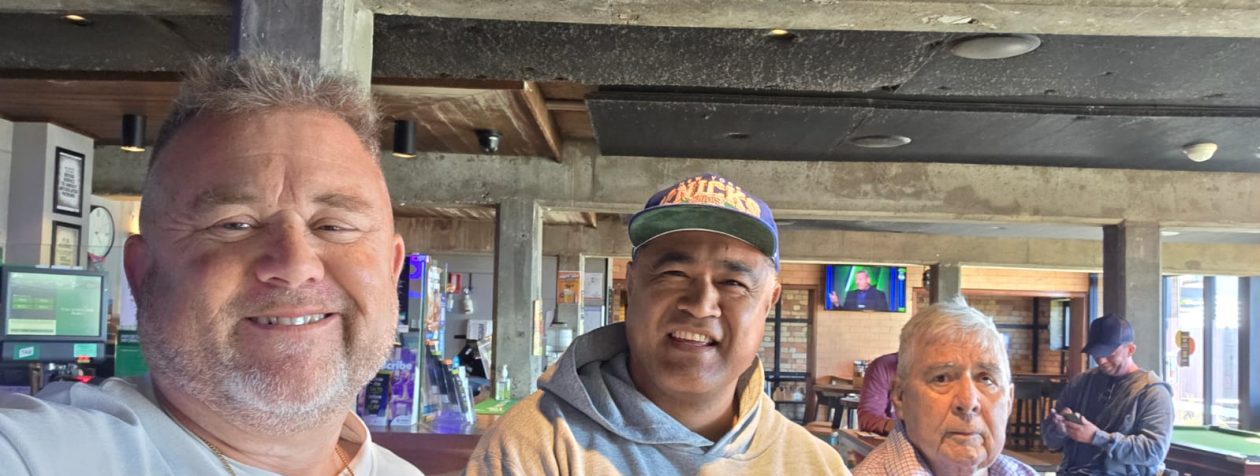
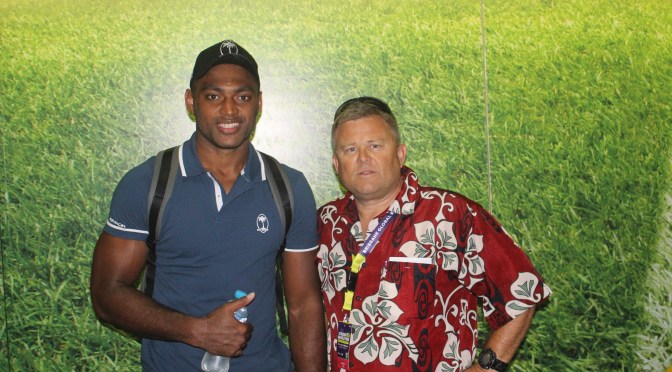


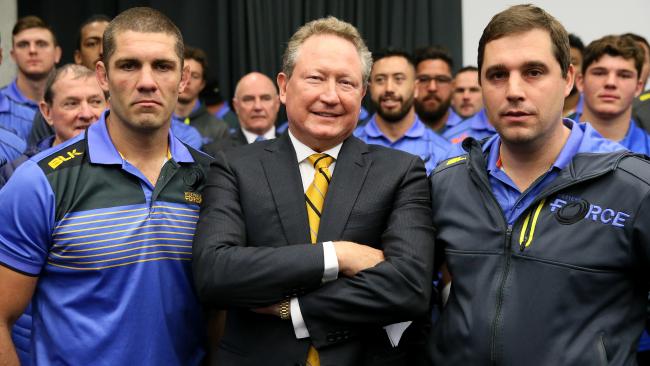
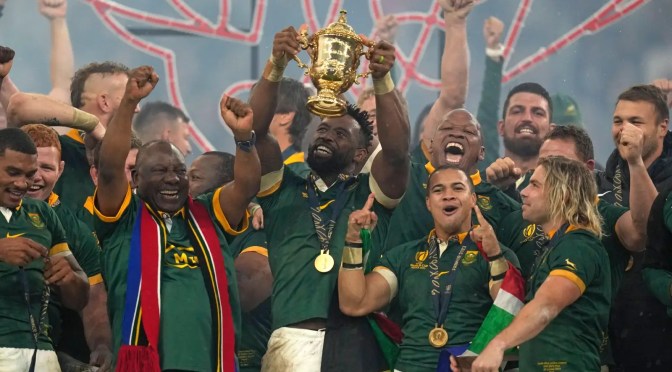
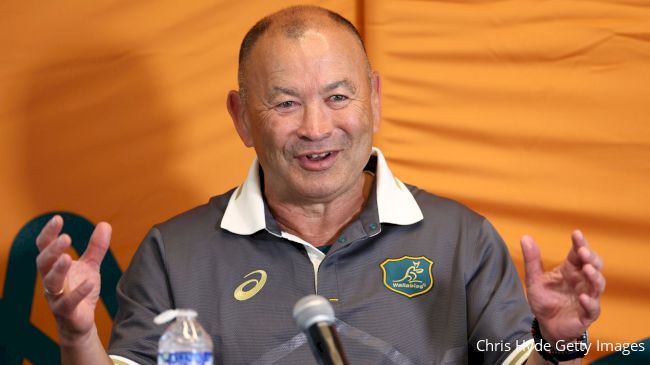

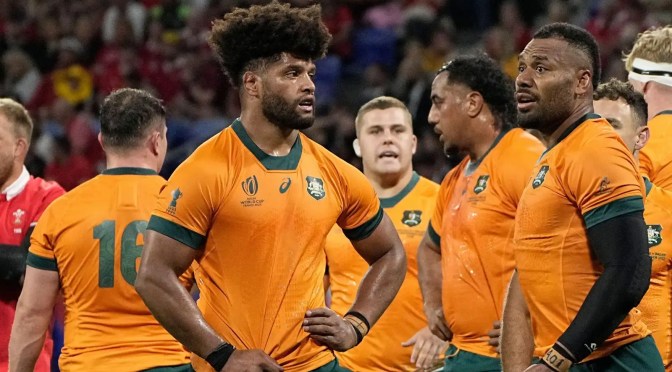
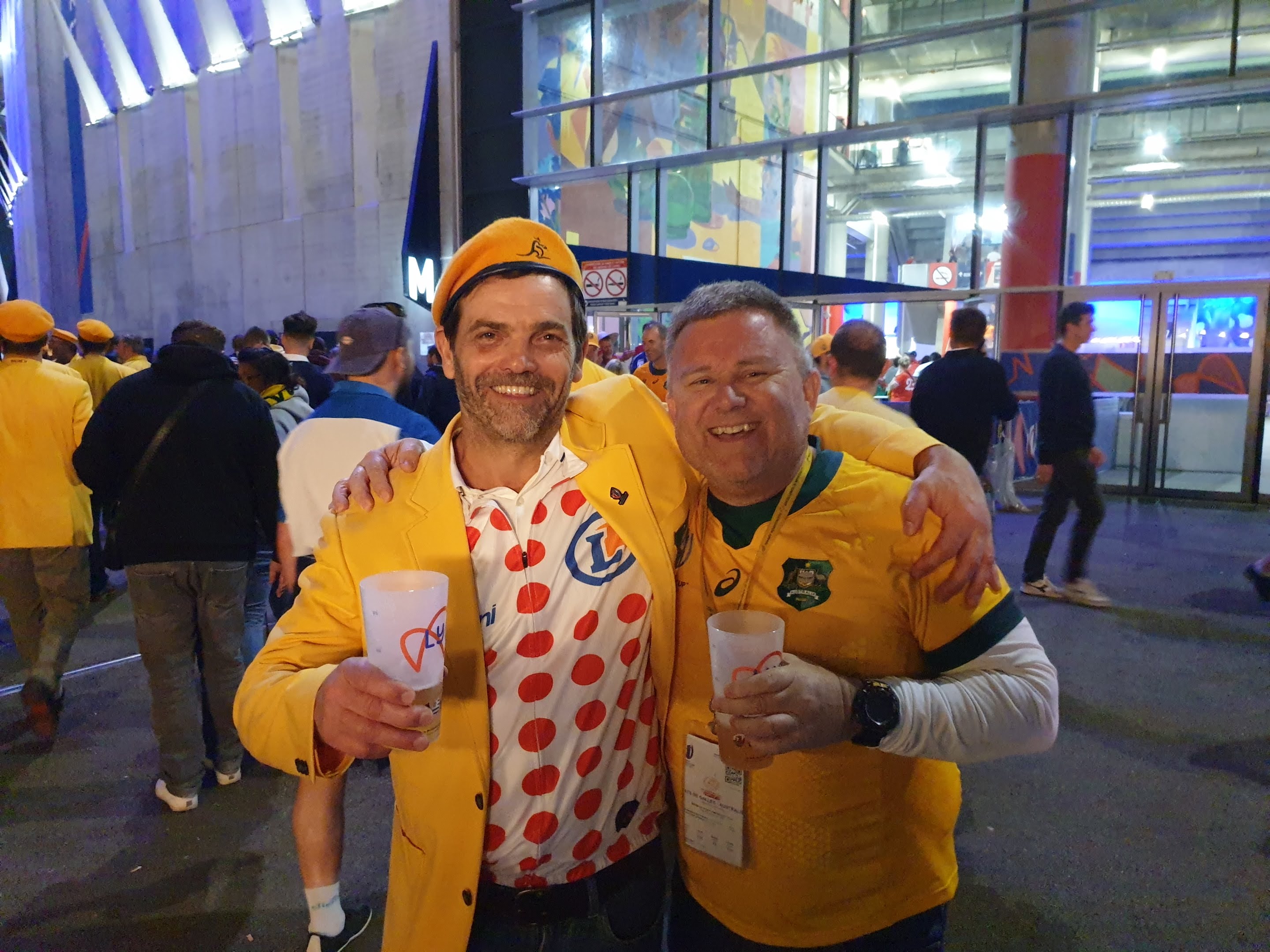

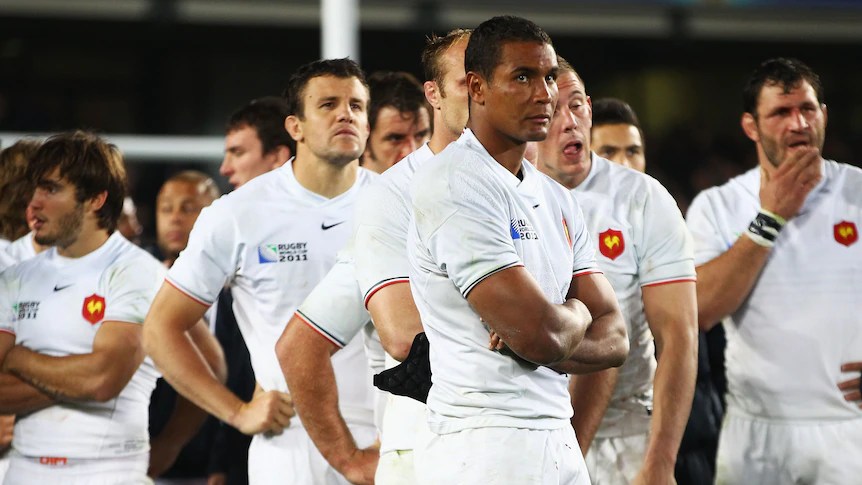
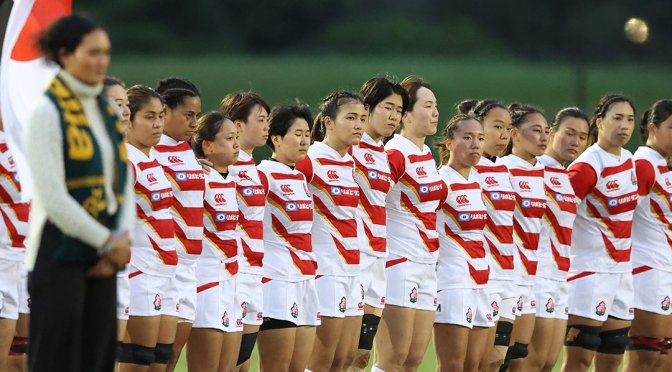


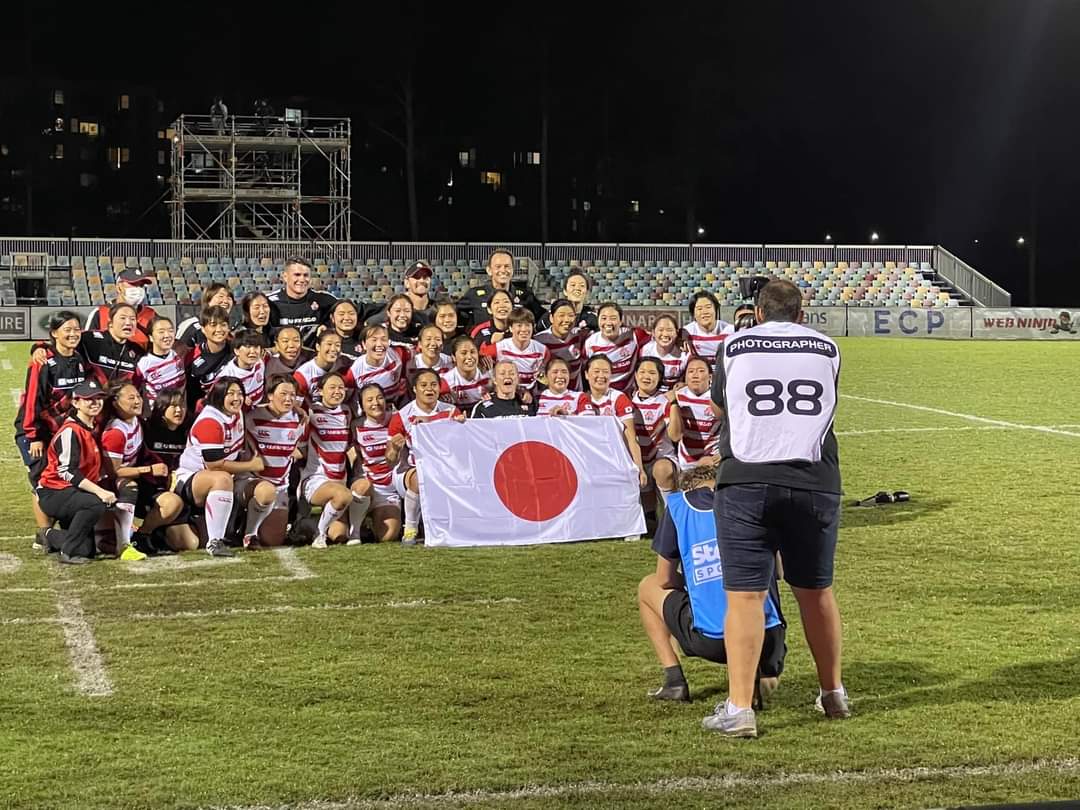
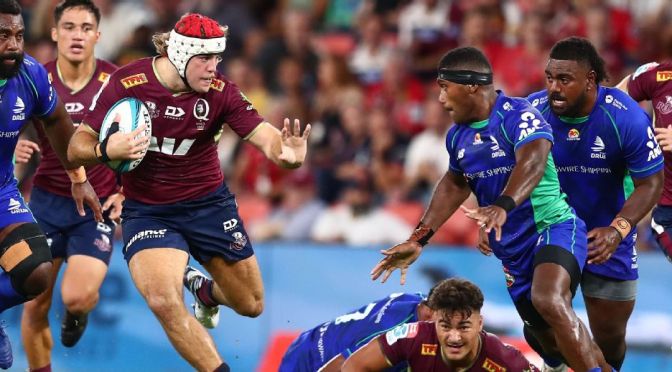

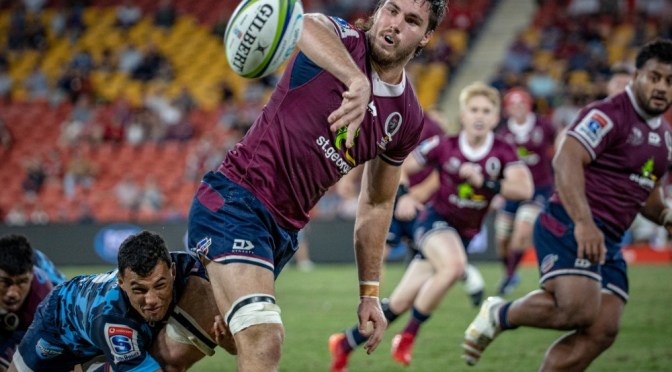
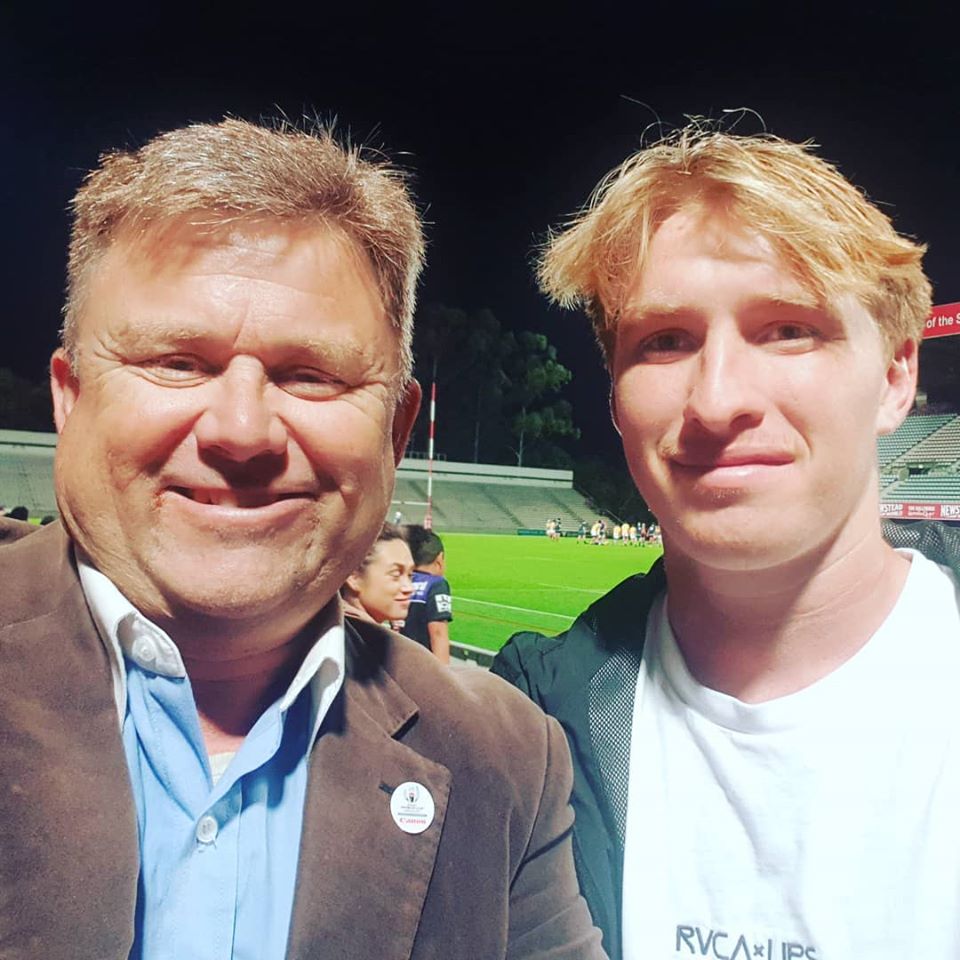



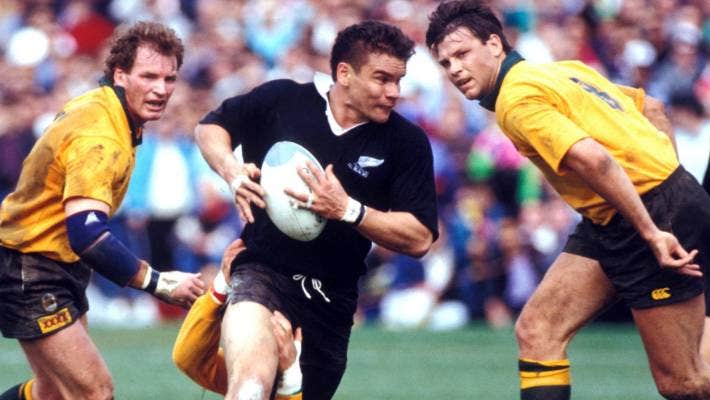

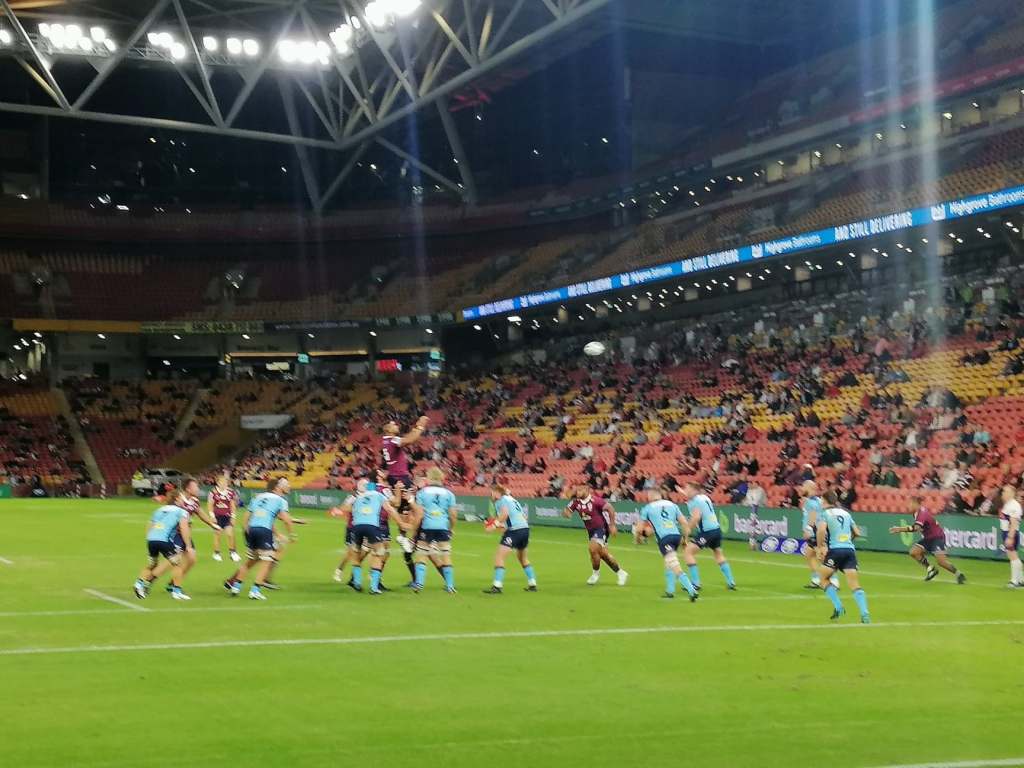


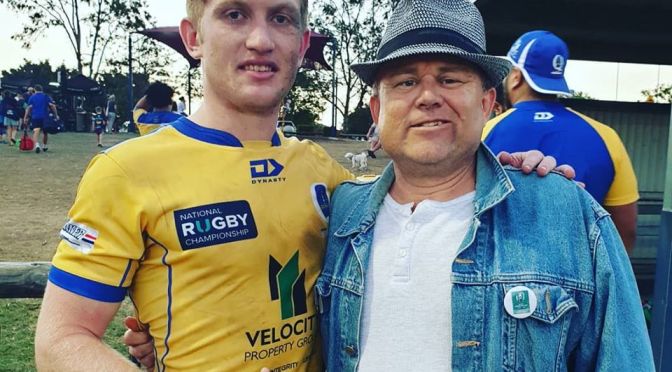
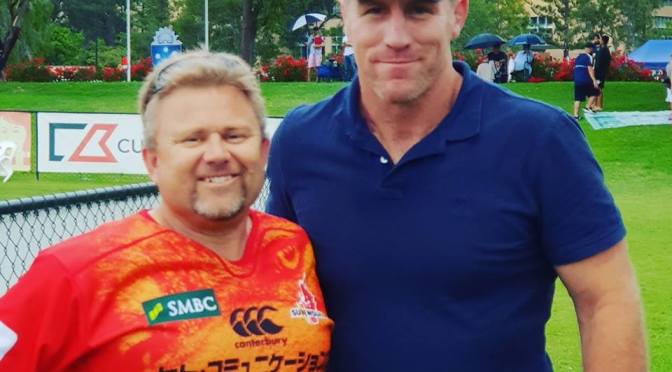
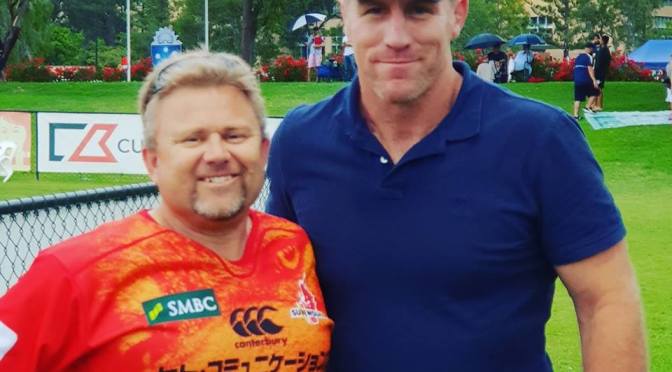


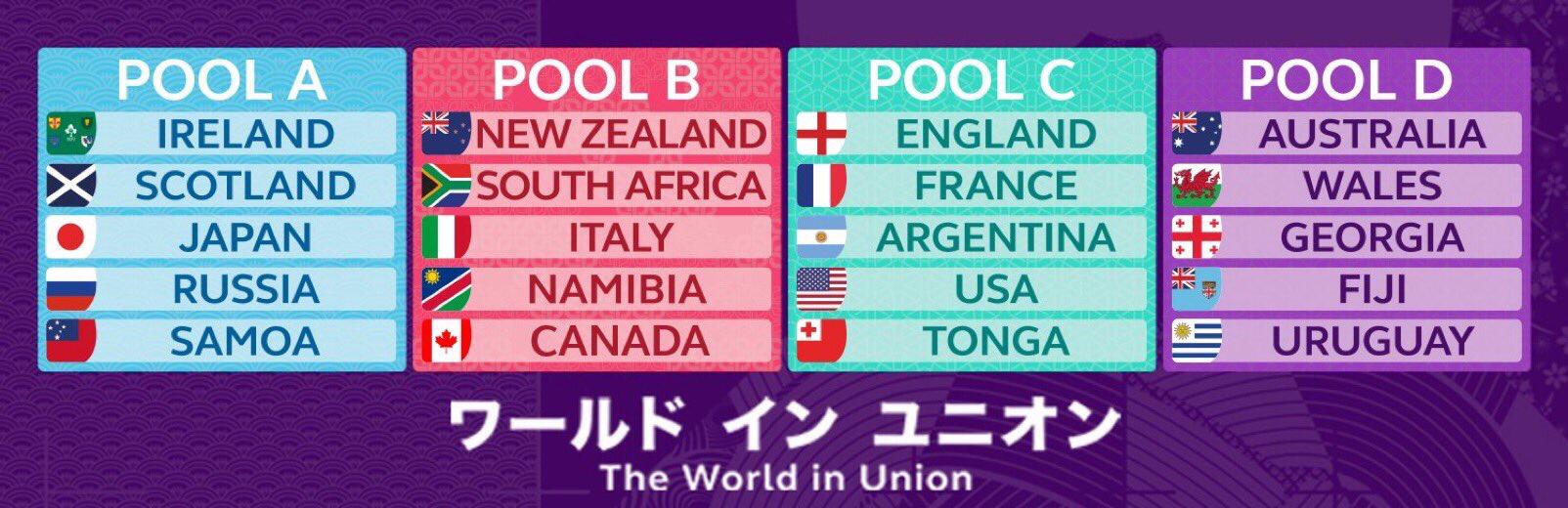
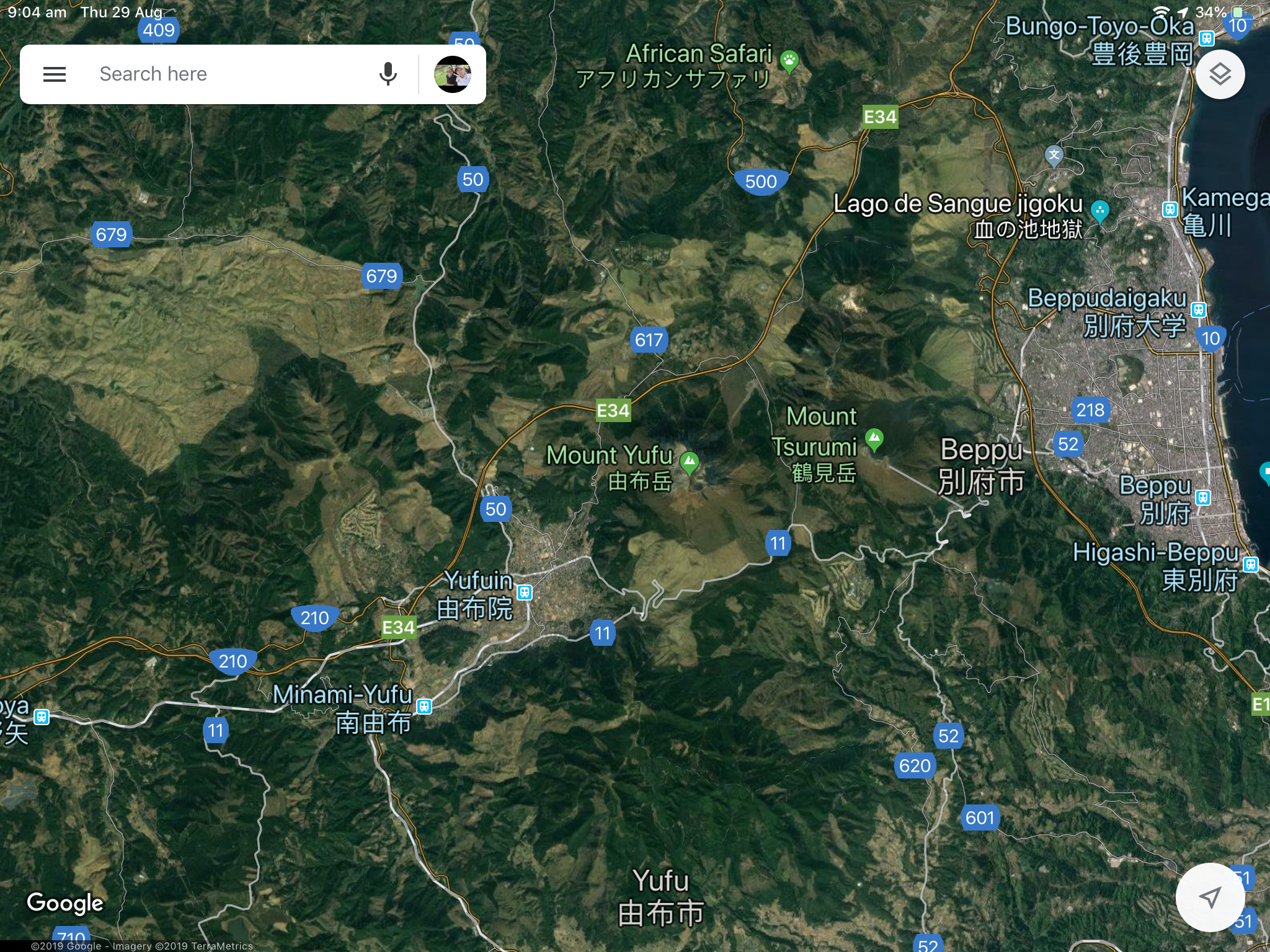
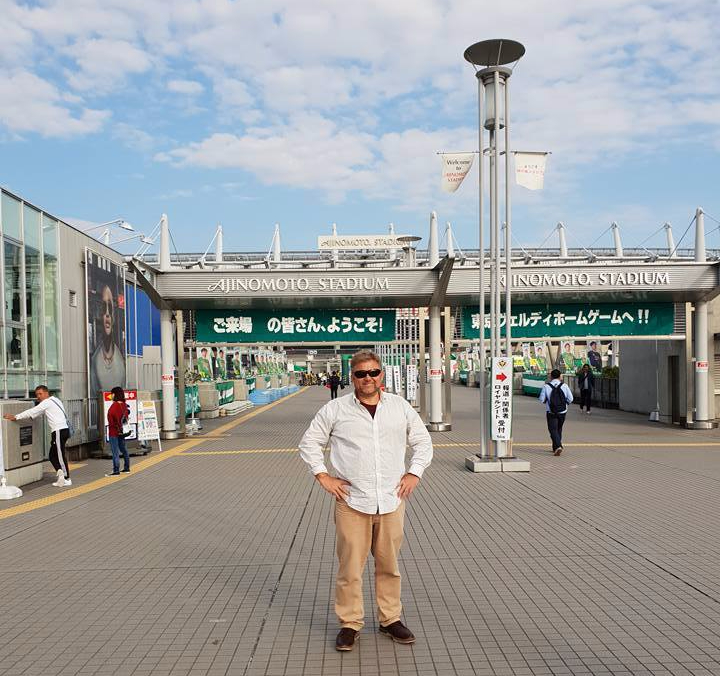


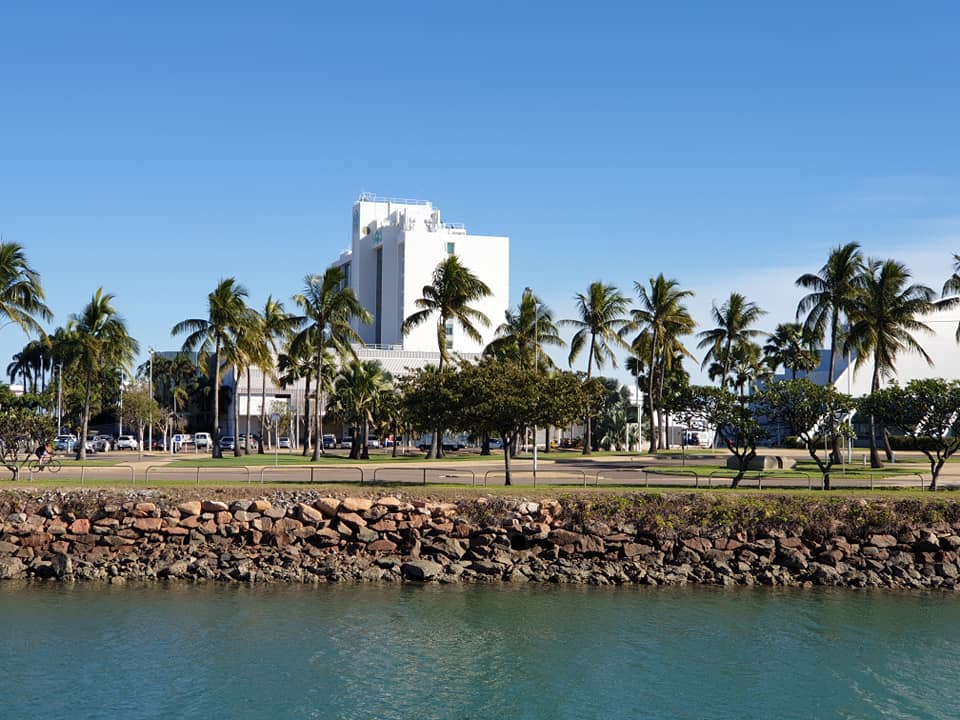



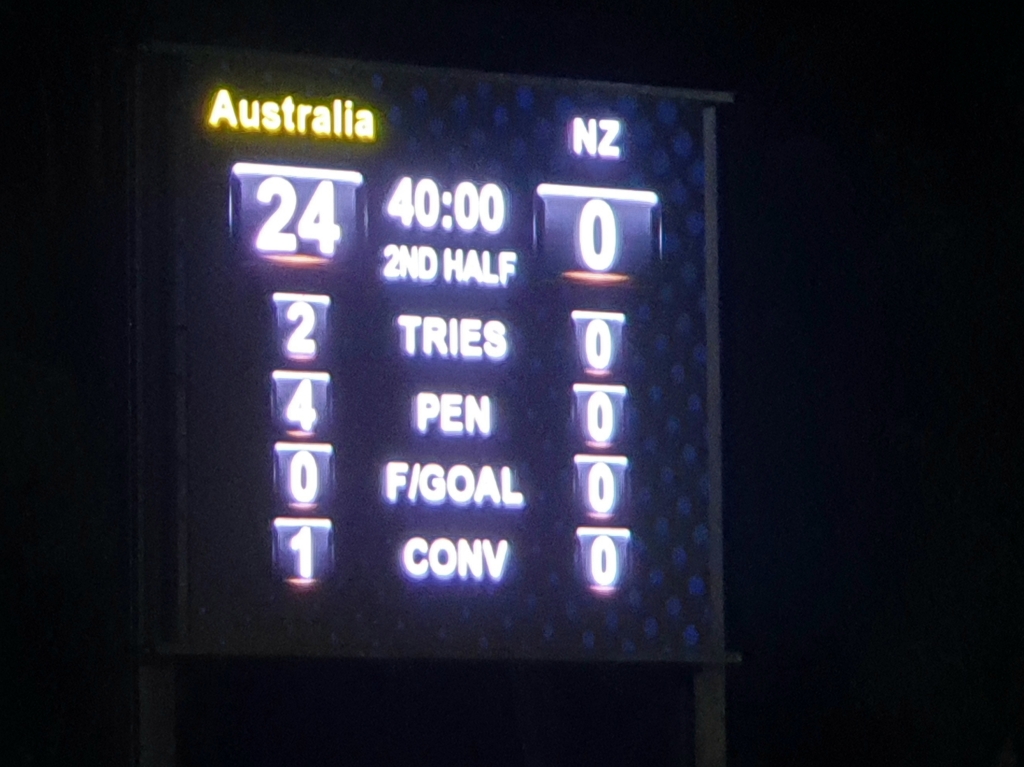
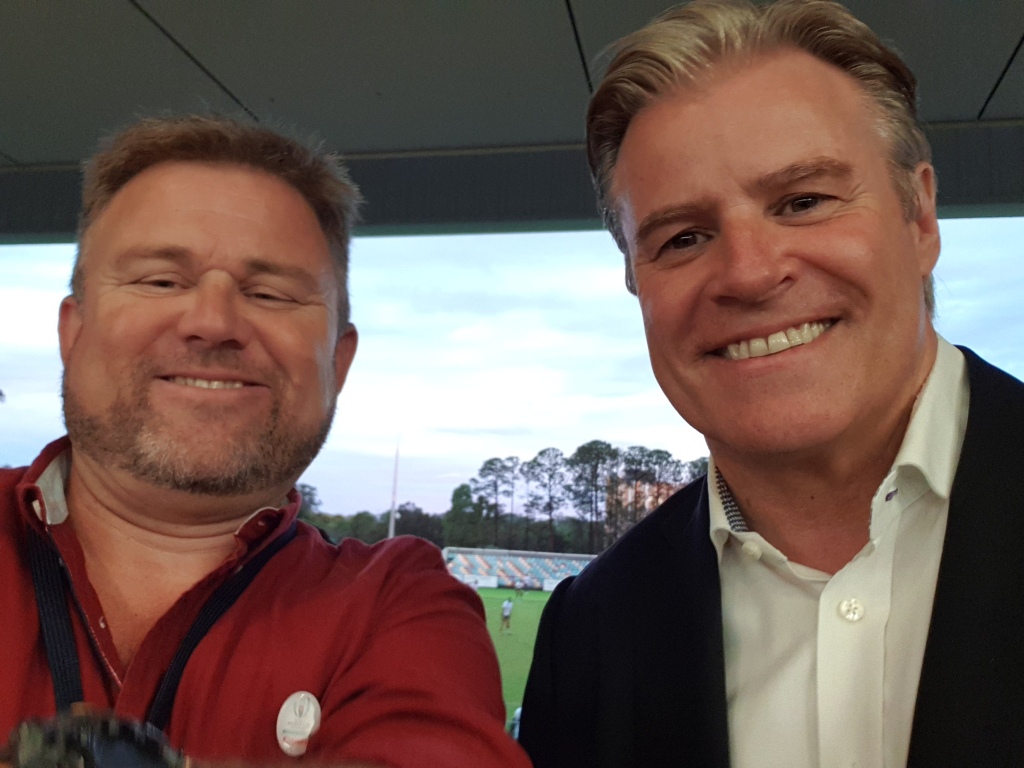

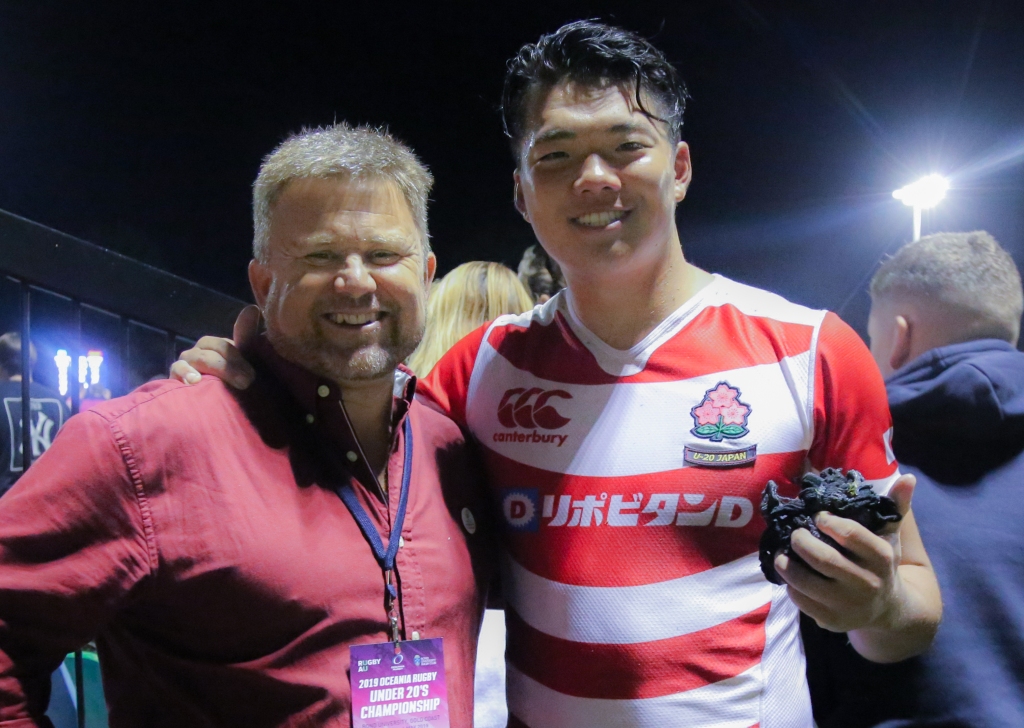
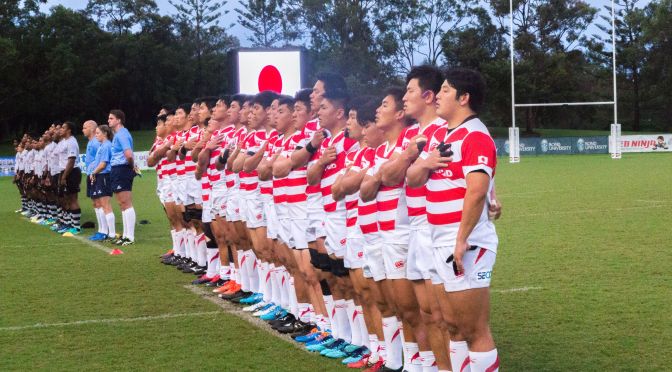

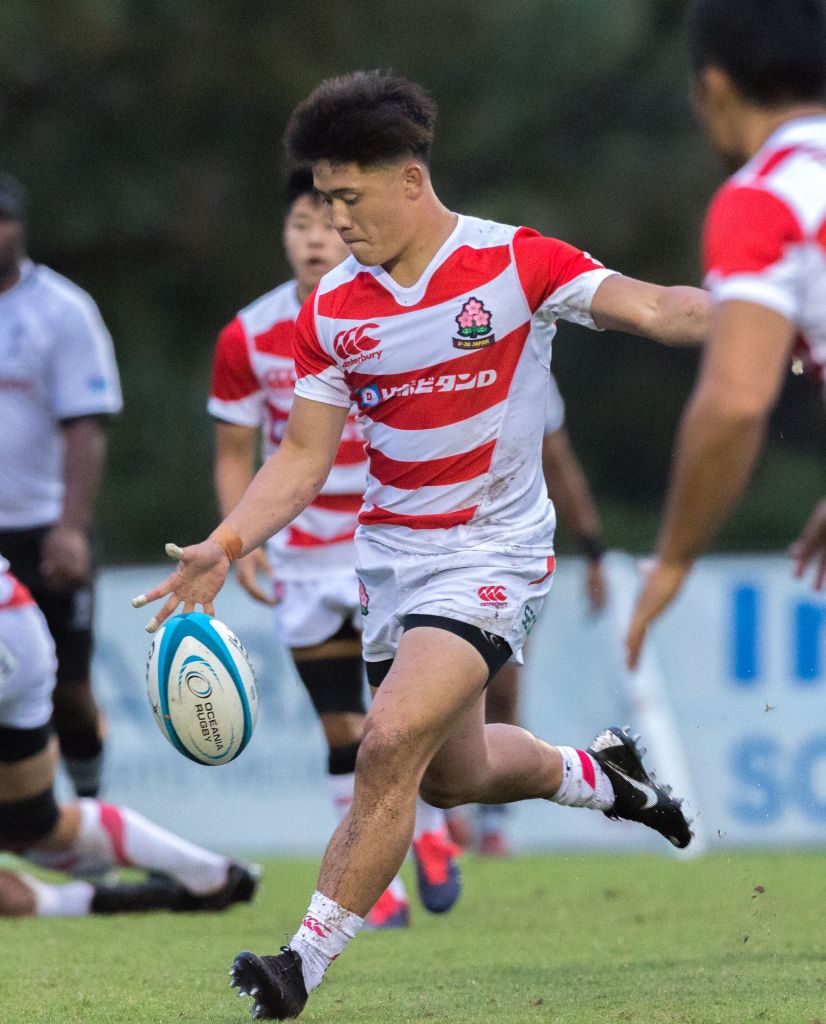

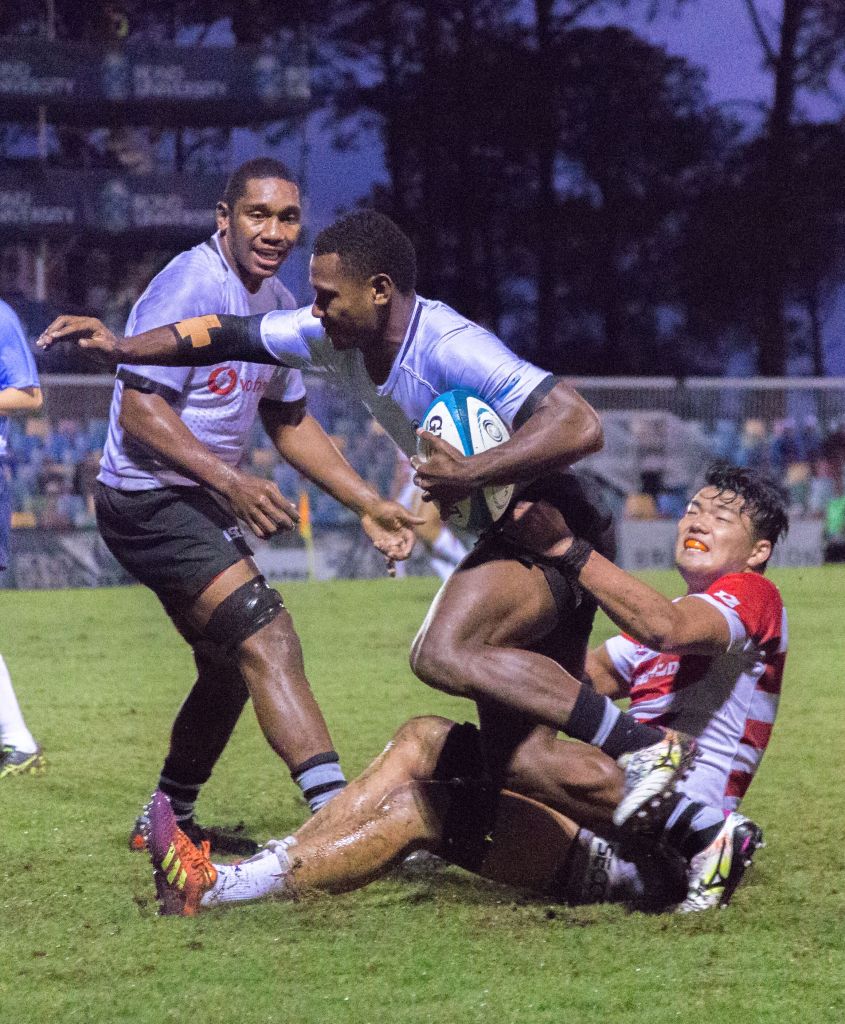
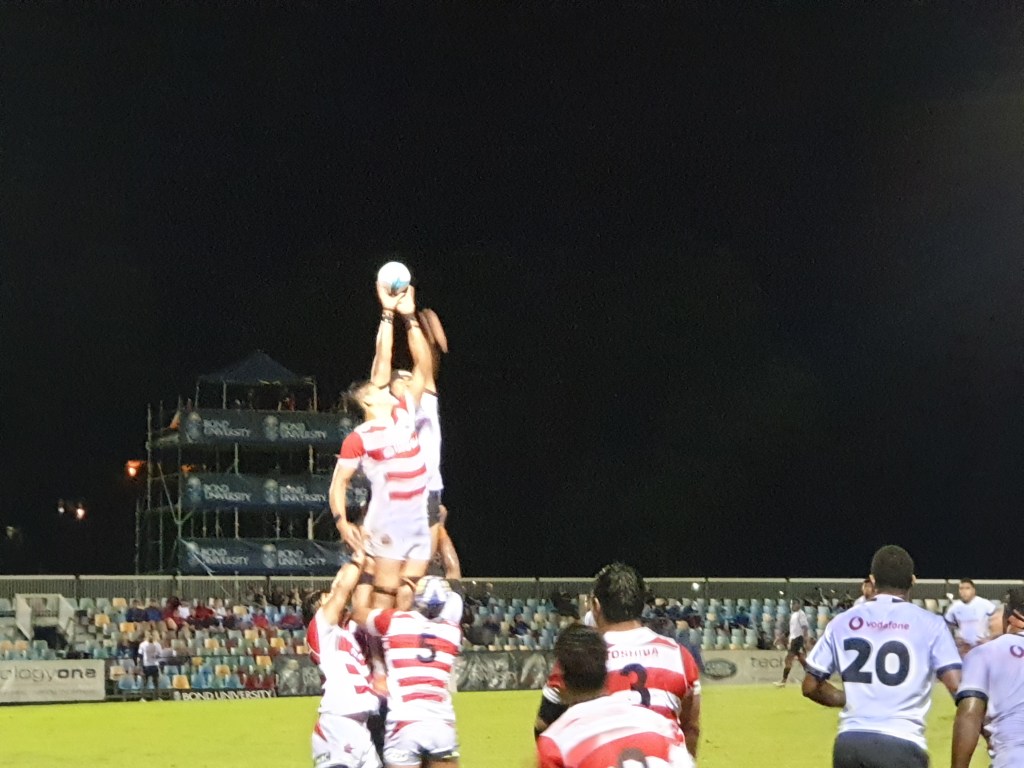


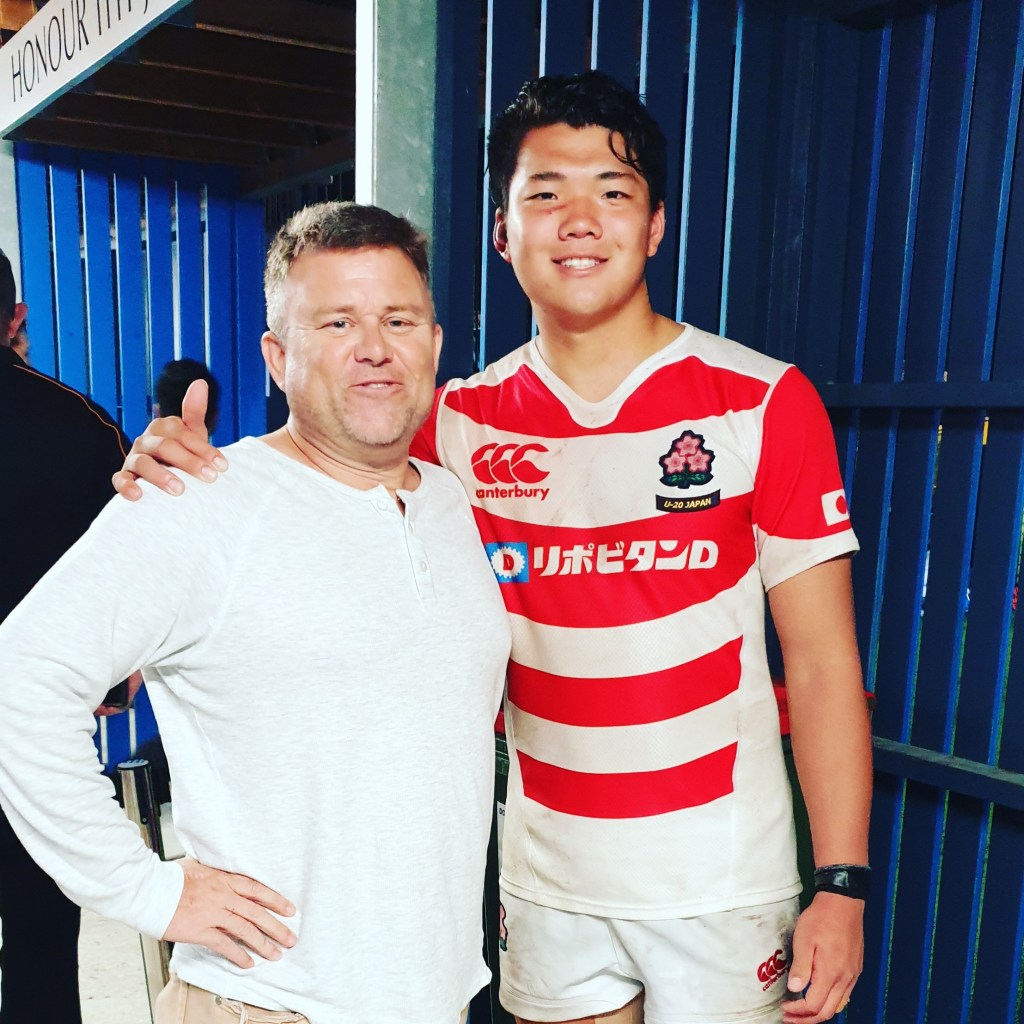





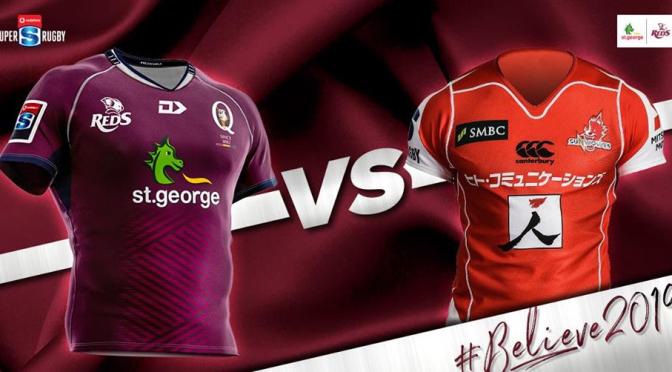




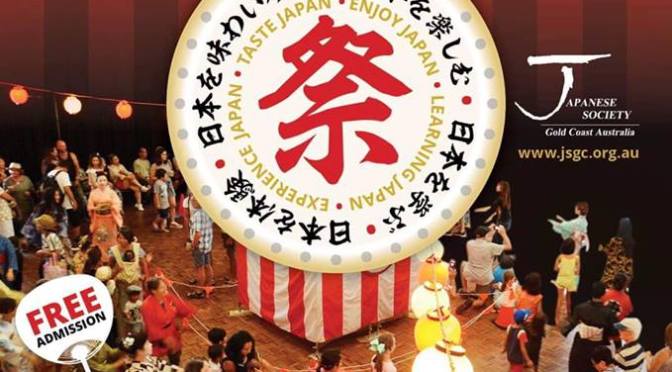
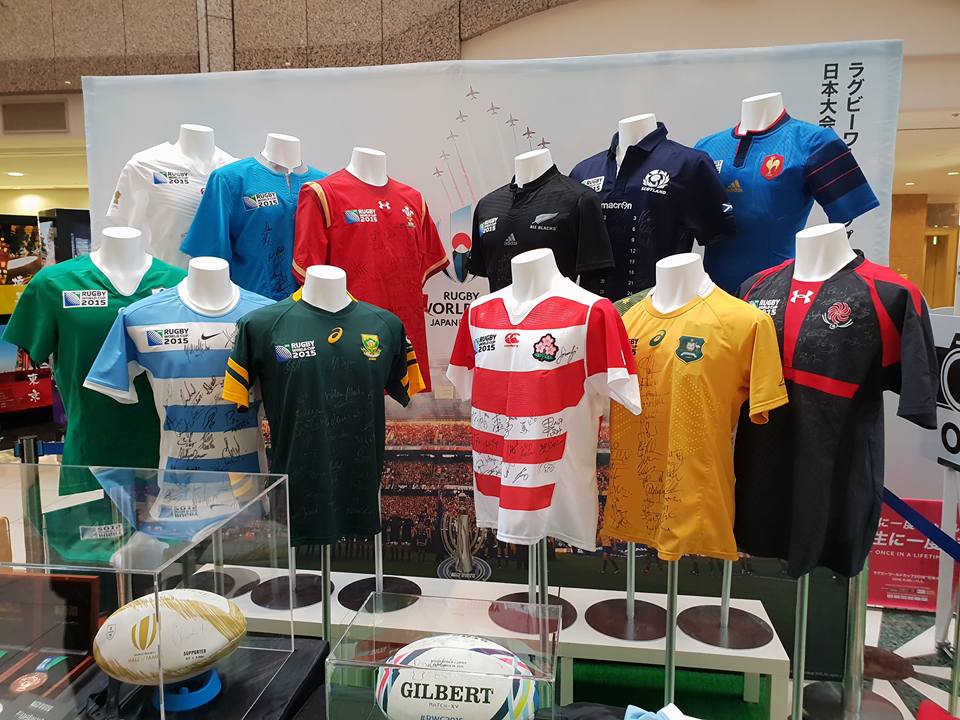
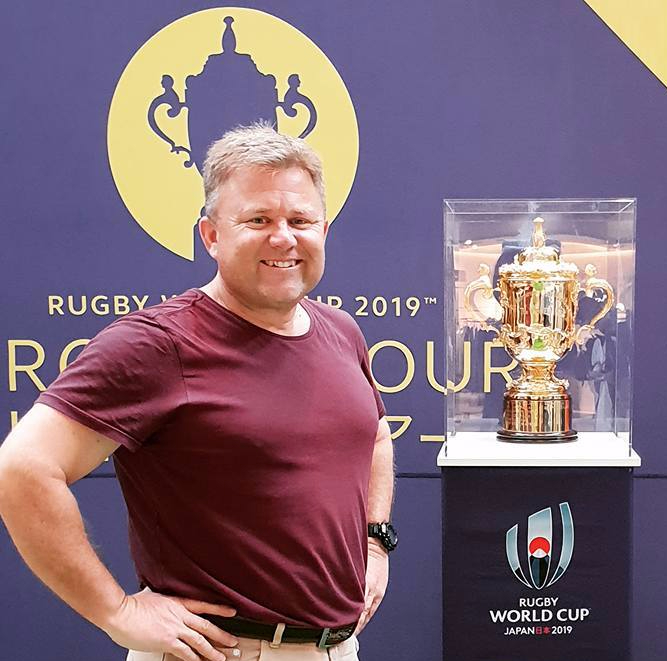
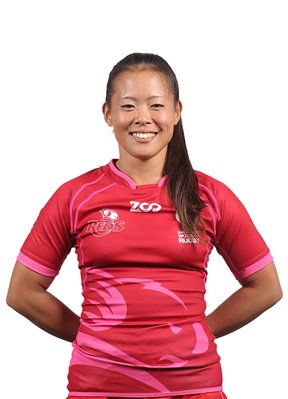


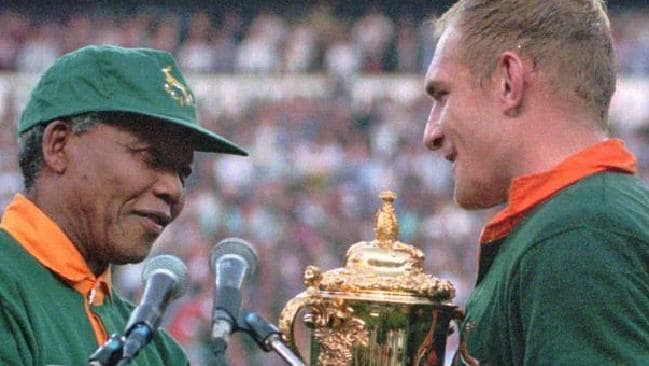


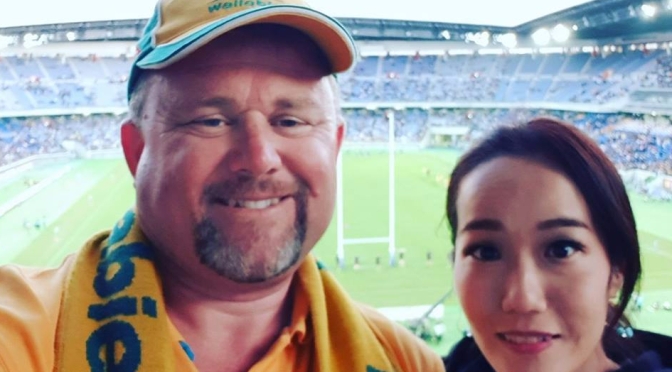




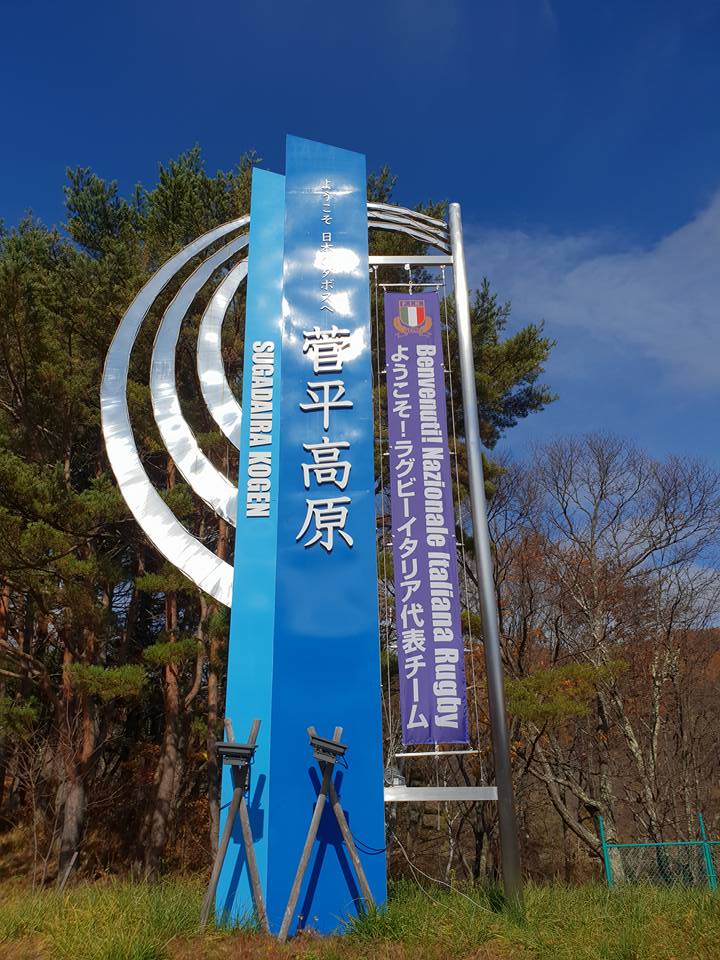

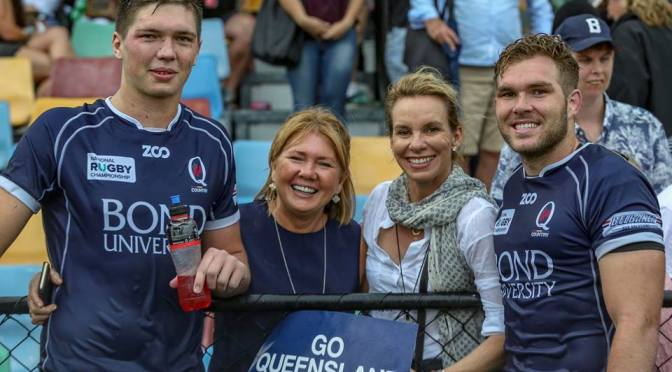
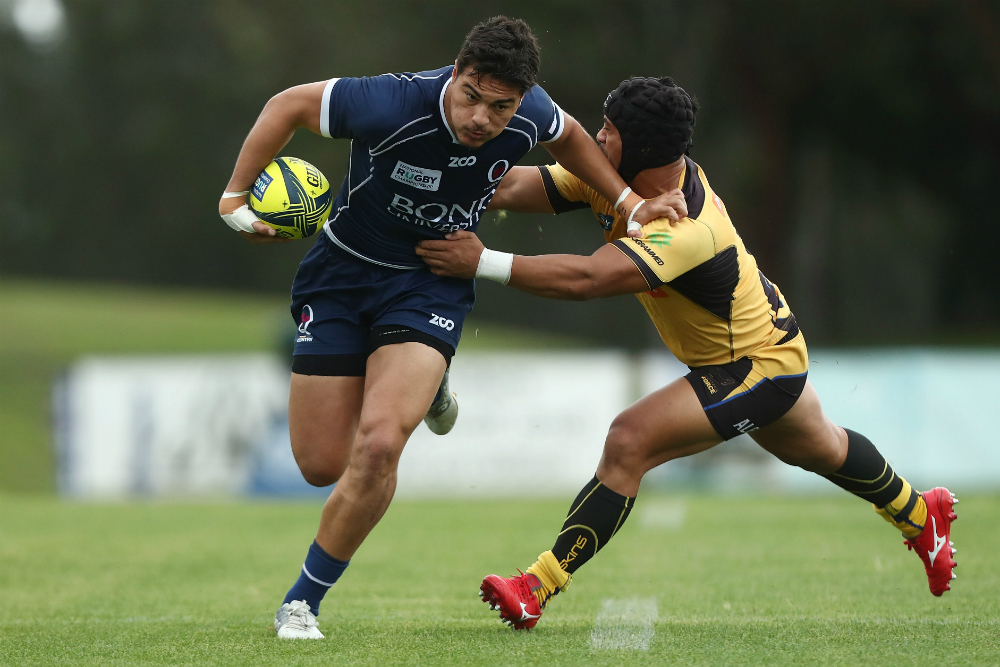
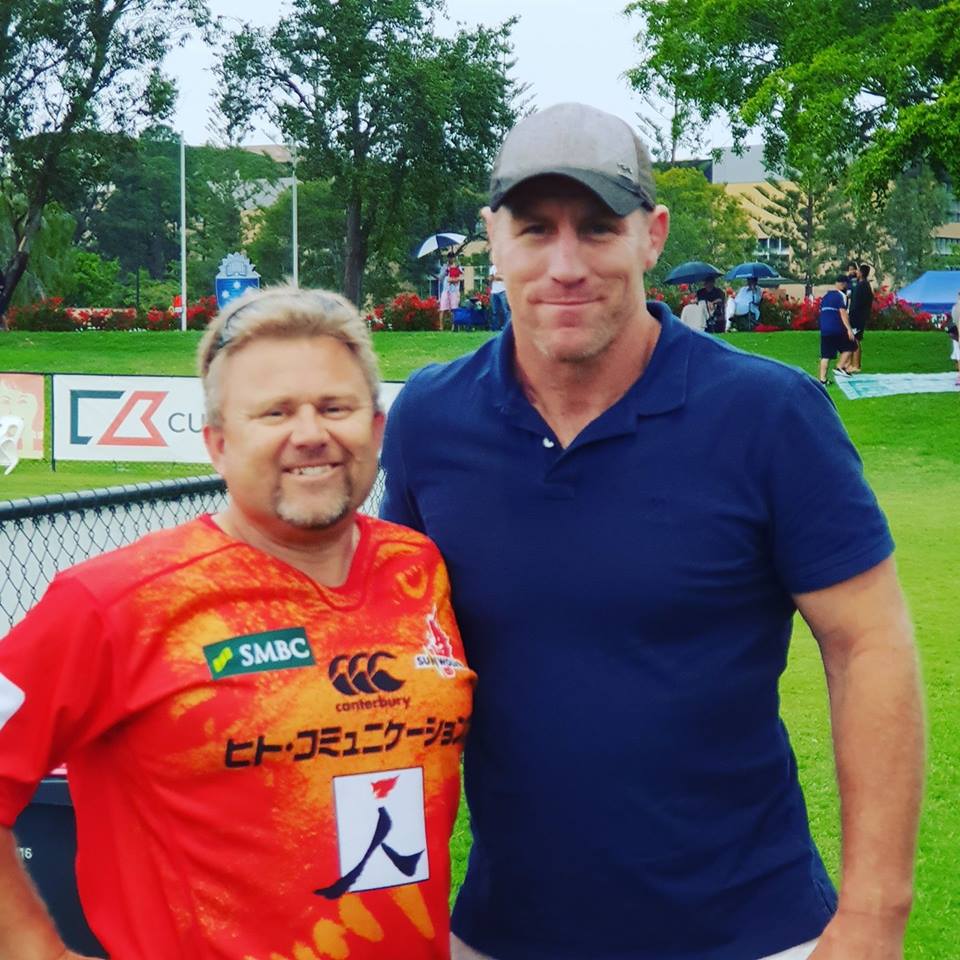
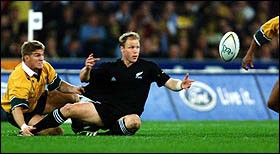
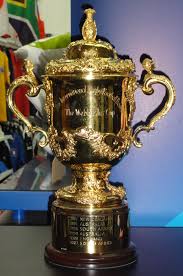 The Aussie campaign to “Bring back Bill”, the affectionate name they have given the William Webb Ellis trophy, is underway and November 6, just three weeks off, is looming as a very significant day for a young nation entering the new millennium.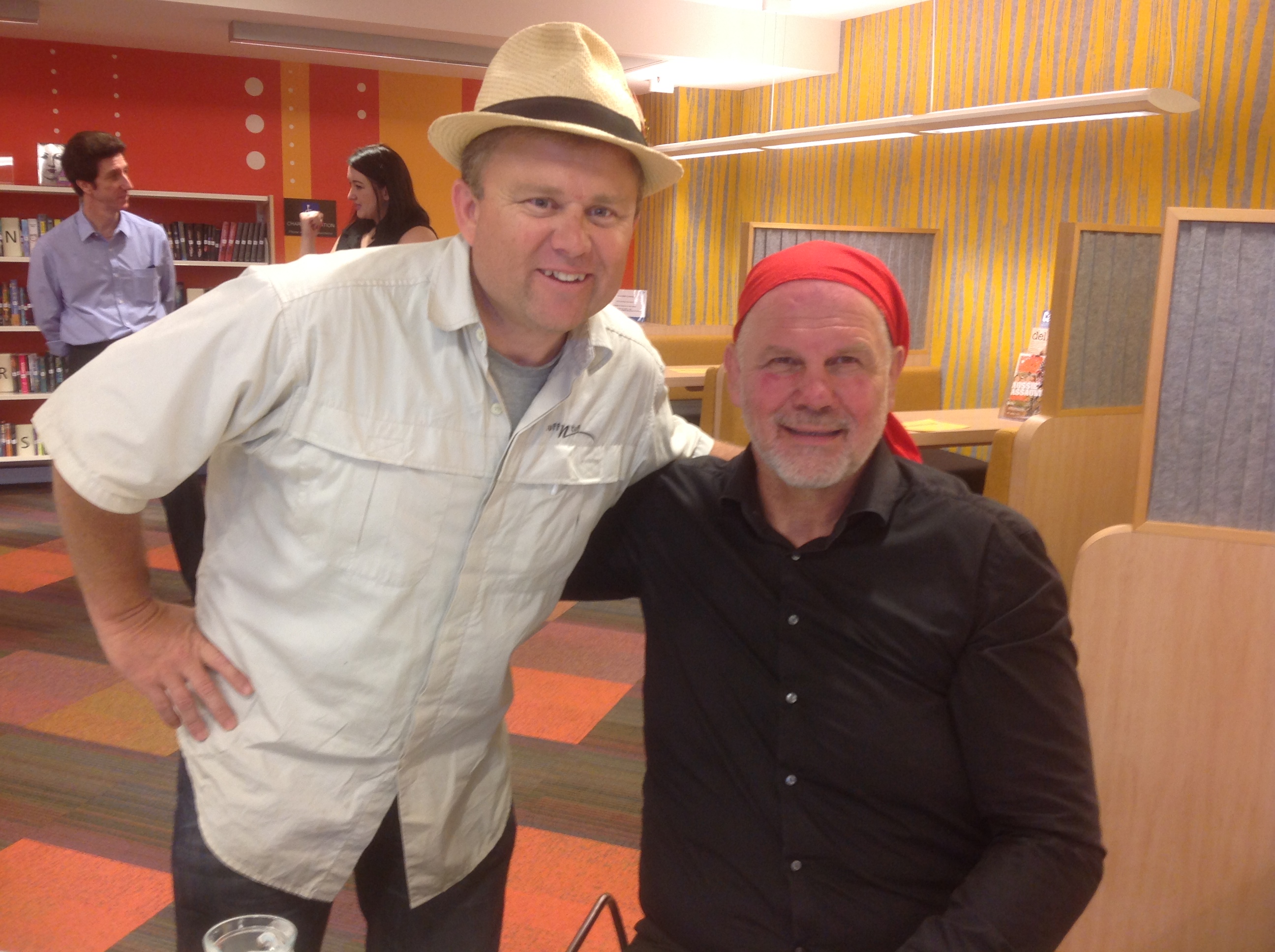
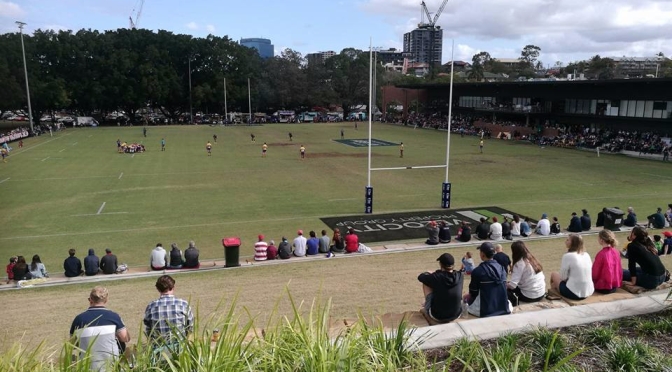
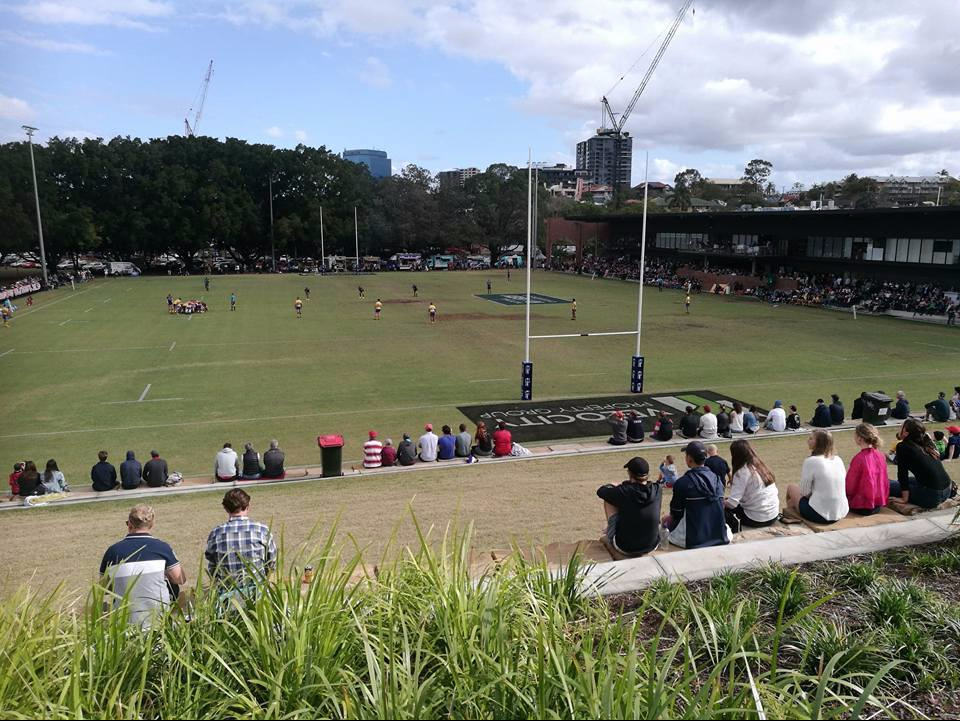


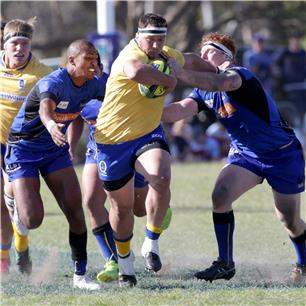
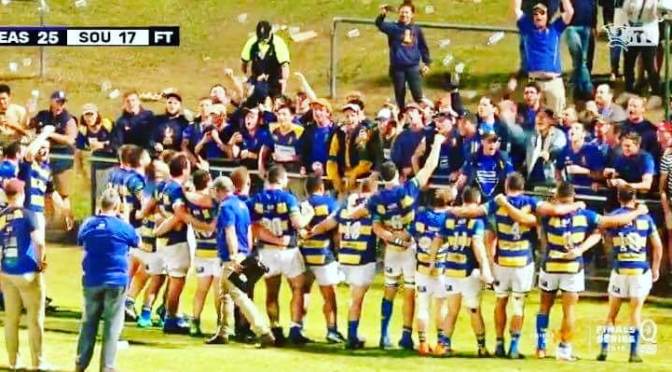
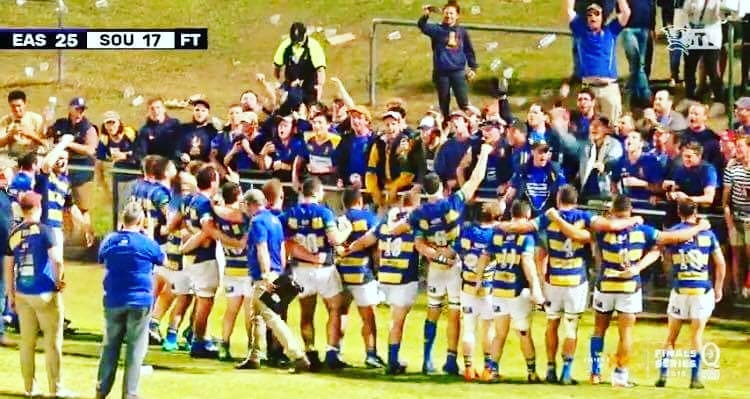



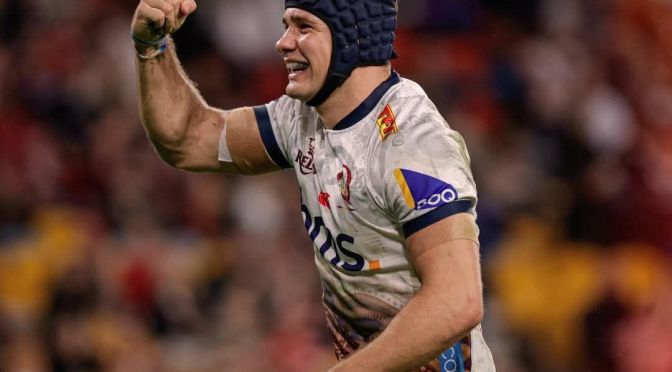
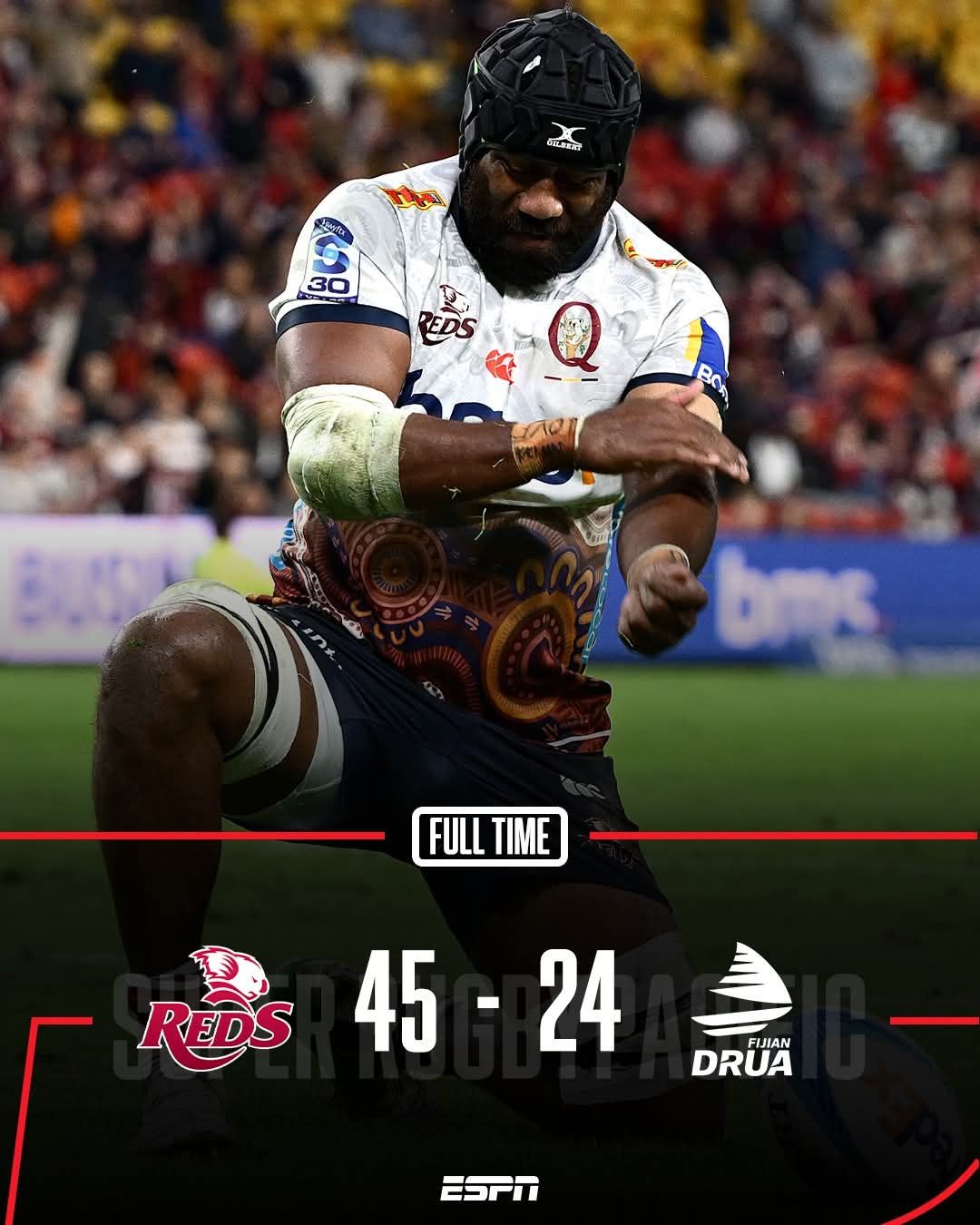
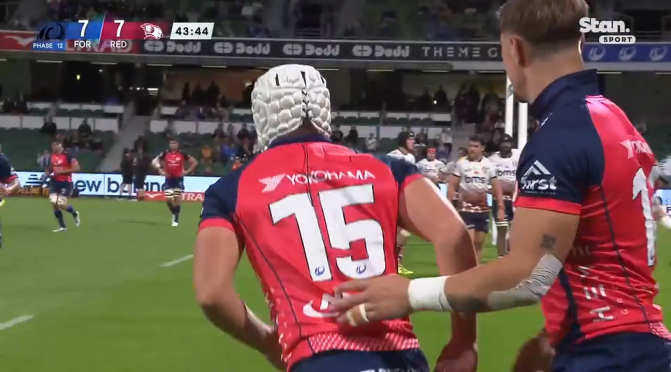
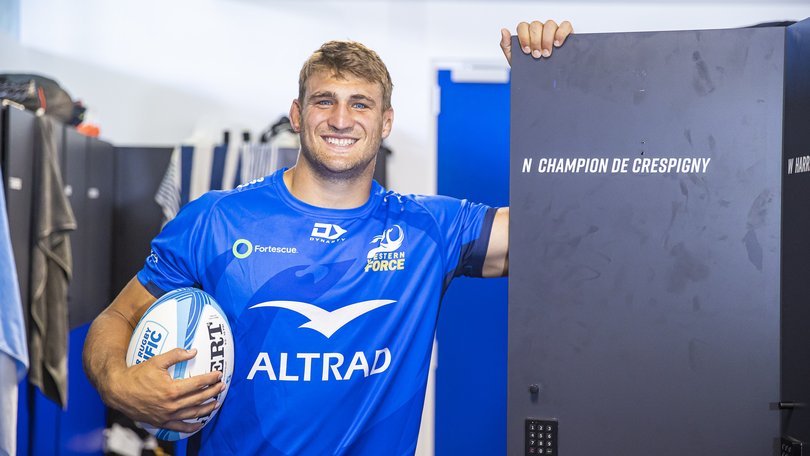
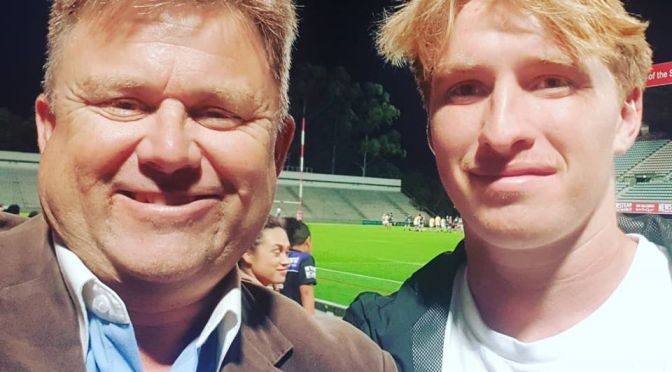
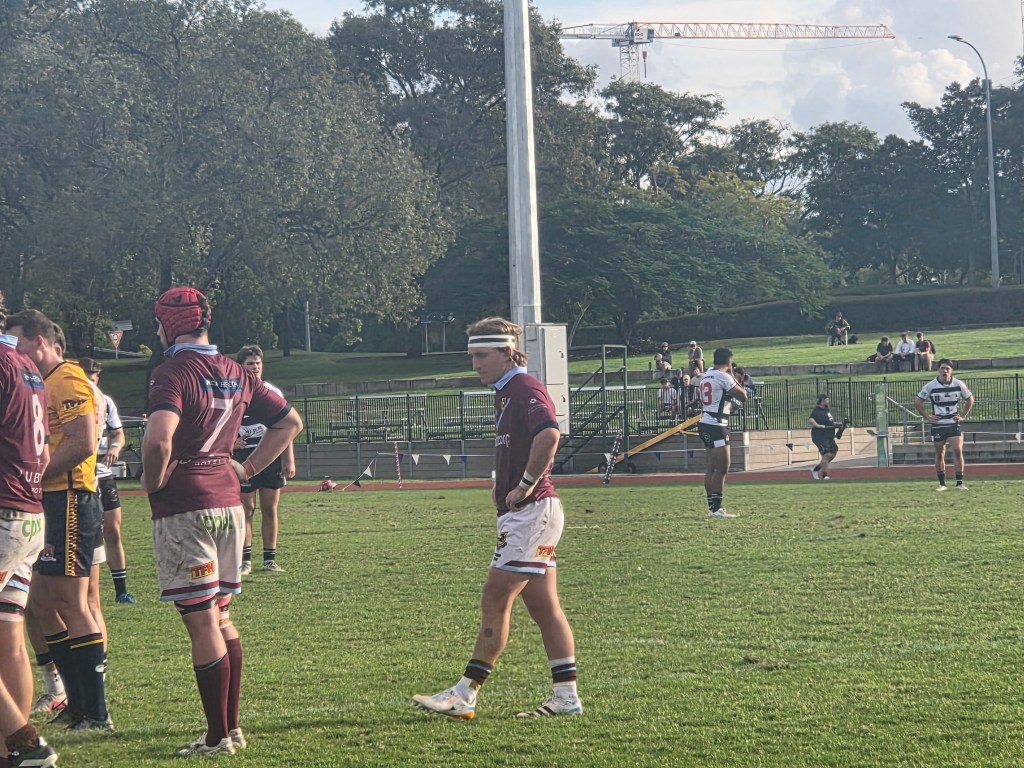
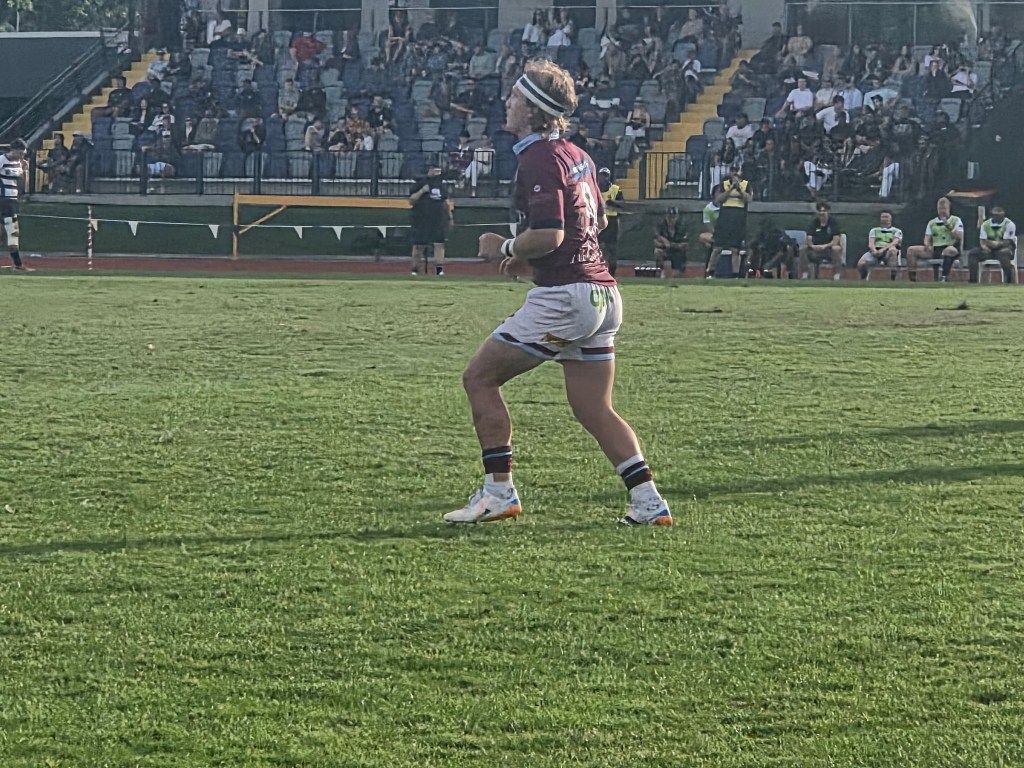
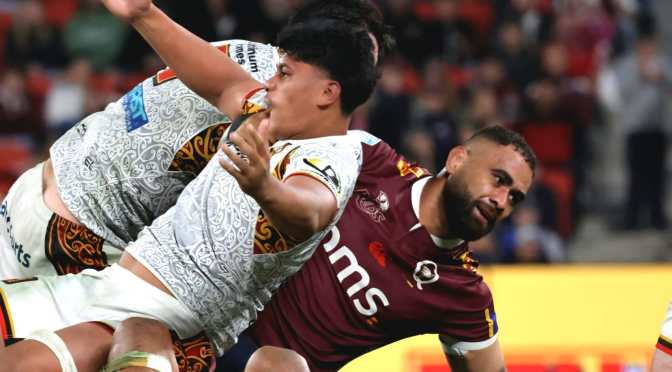
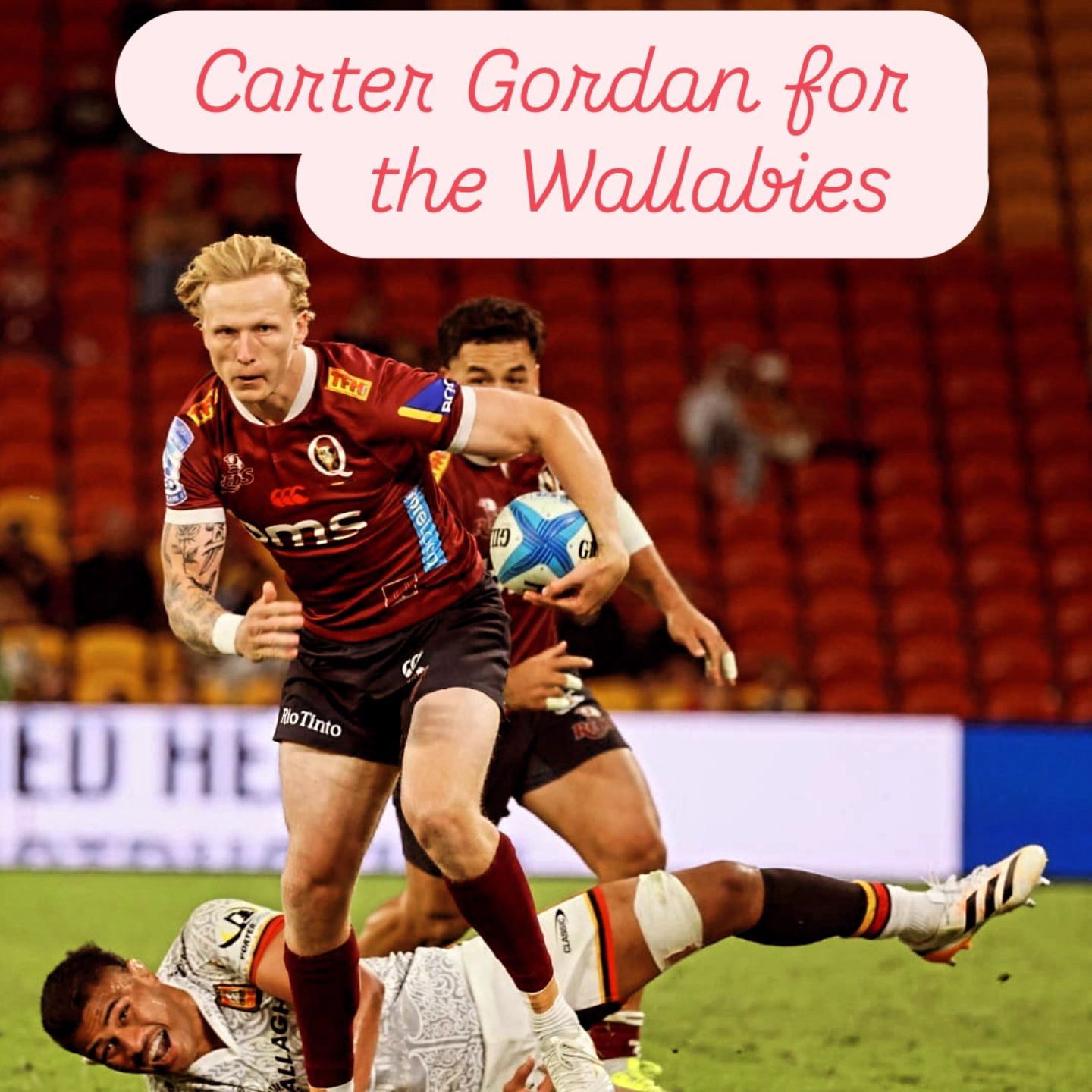
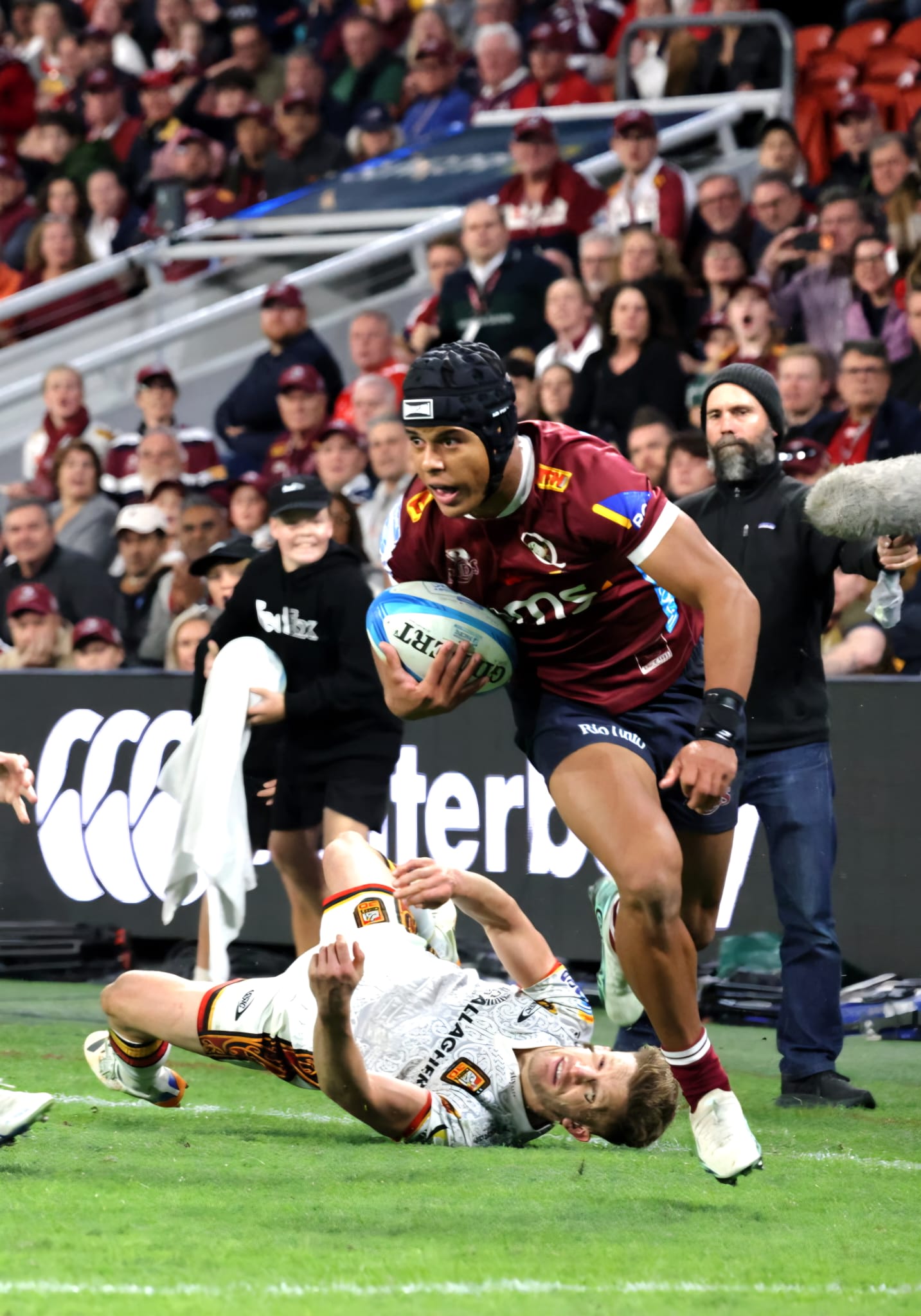
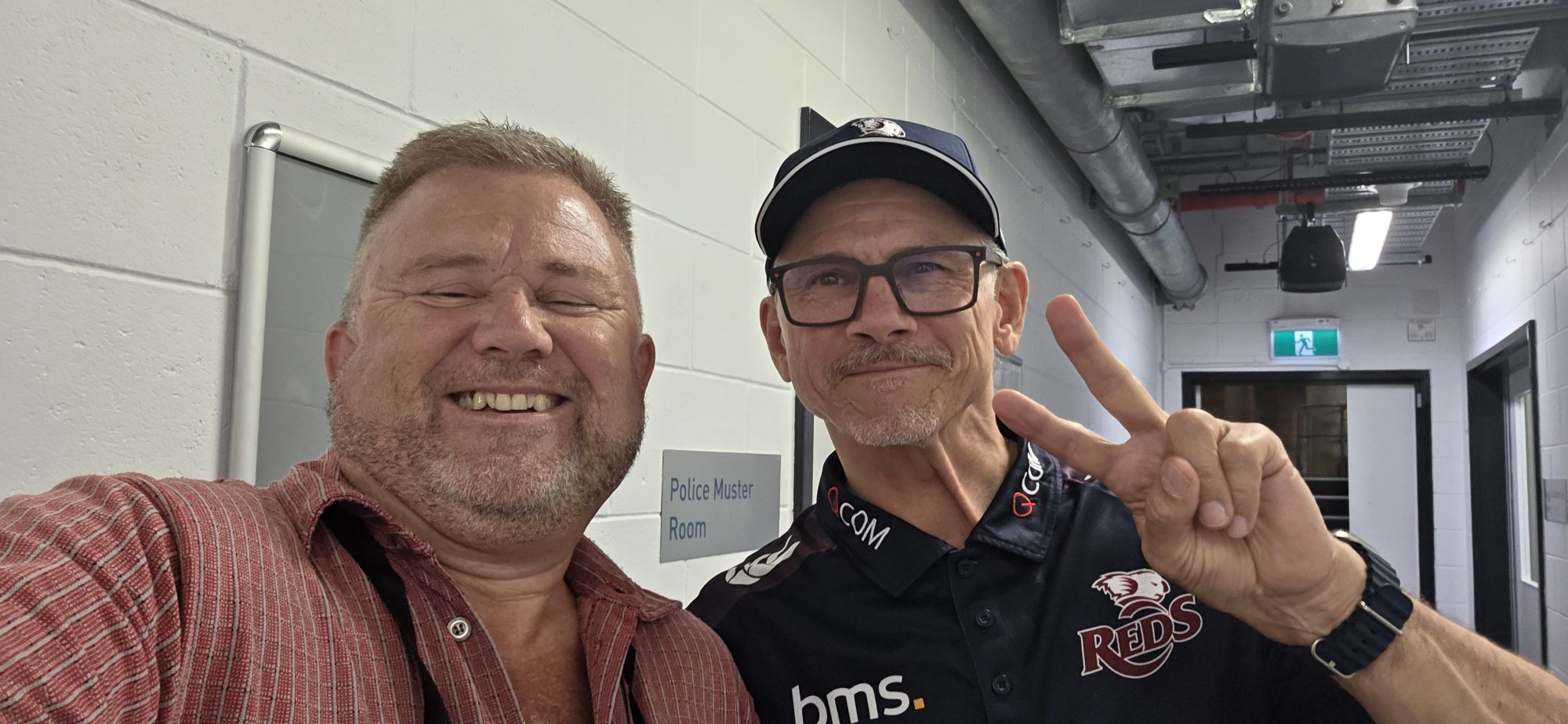
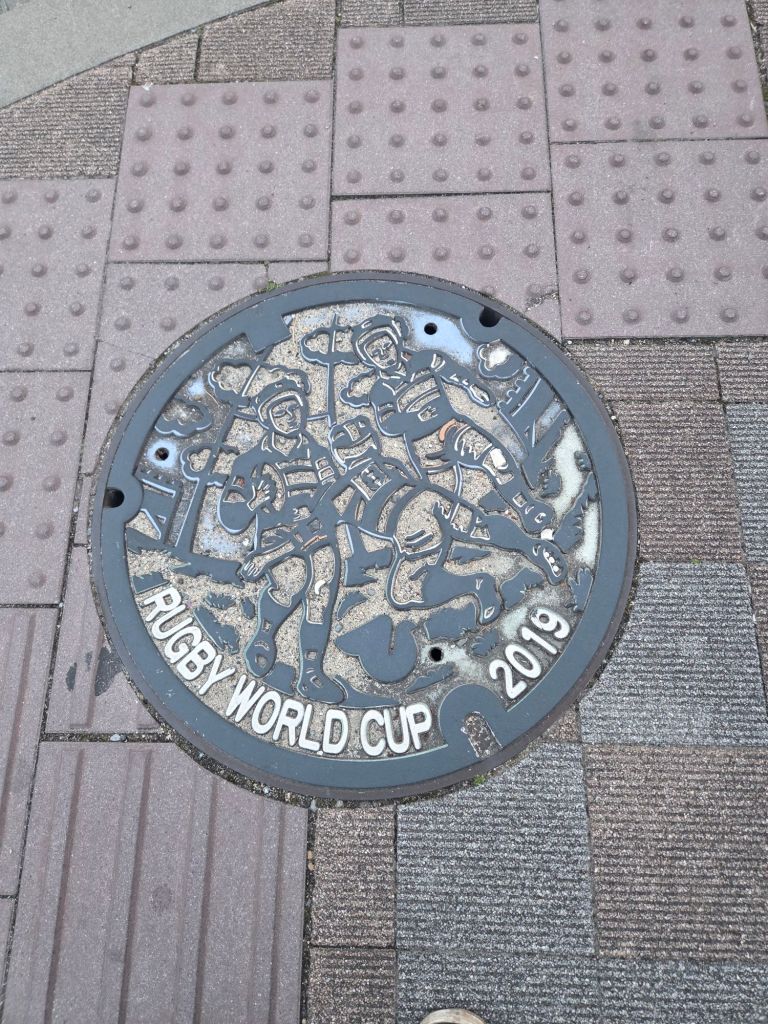
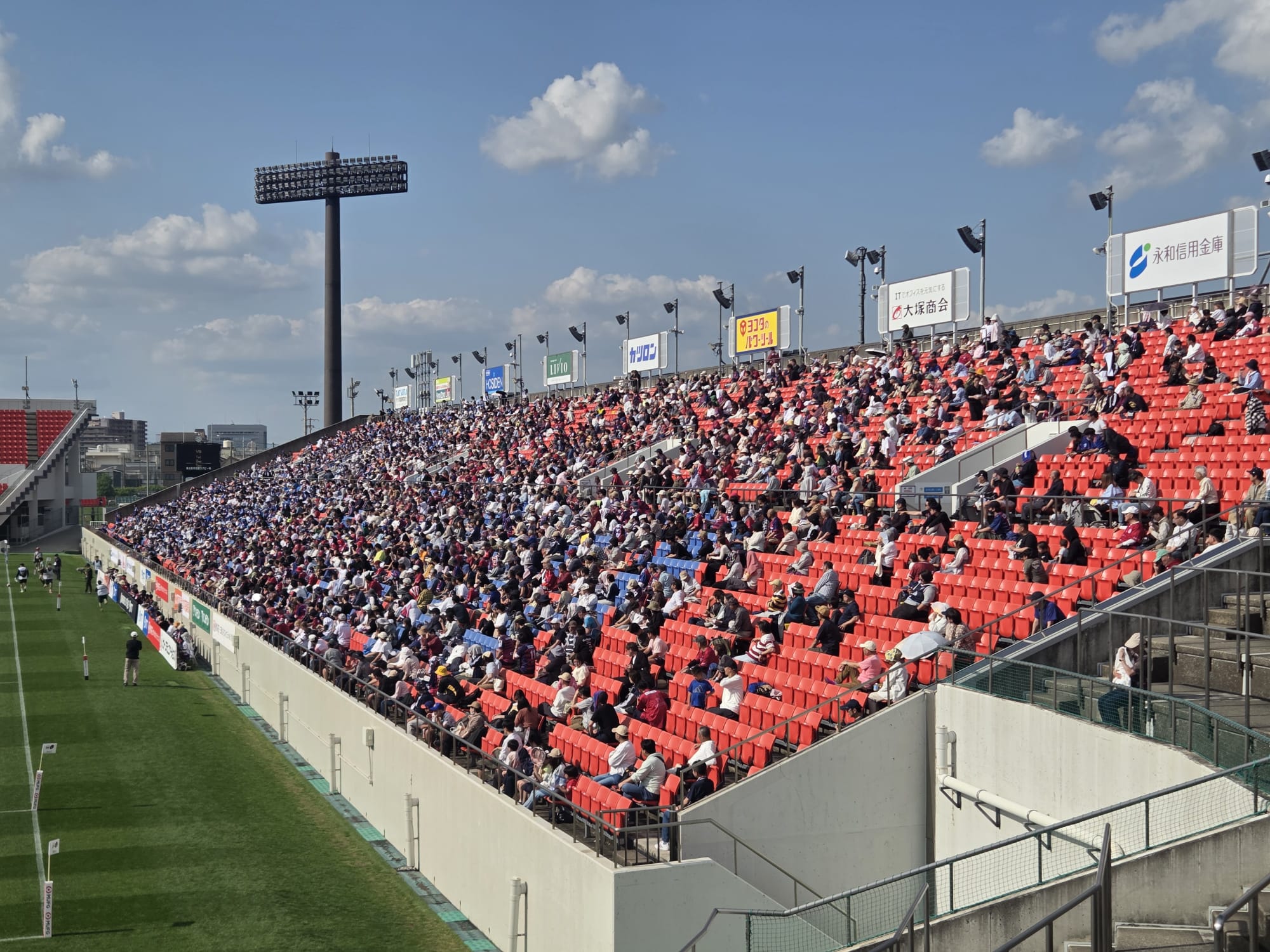
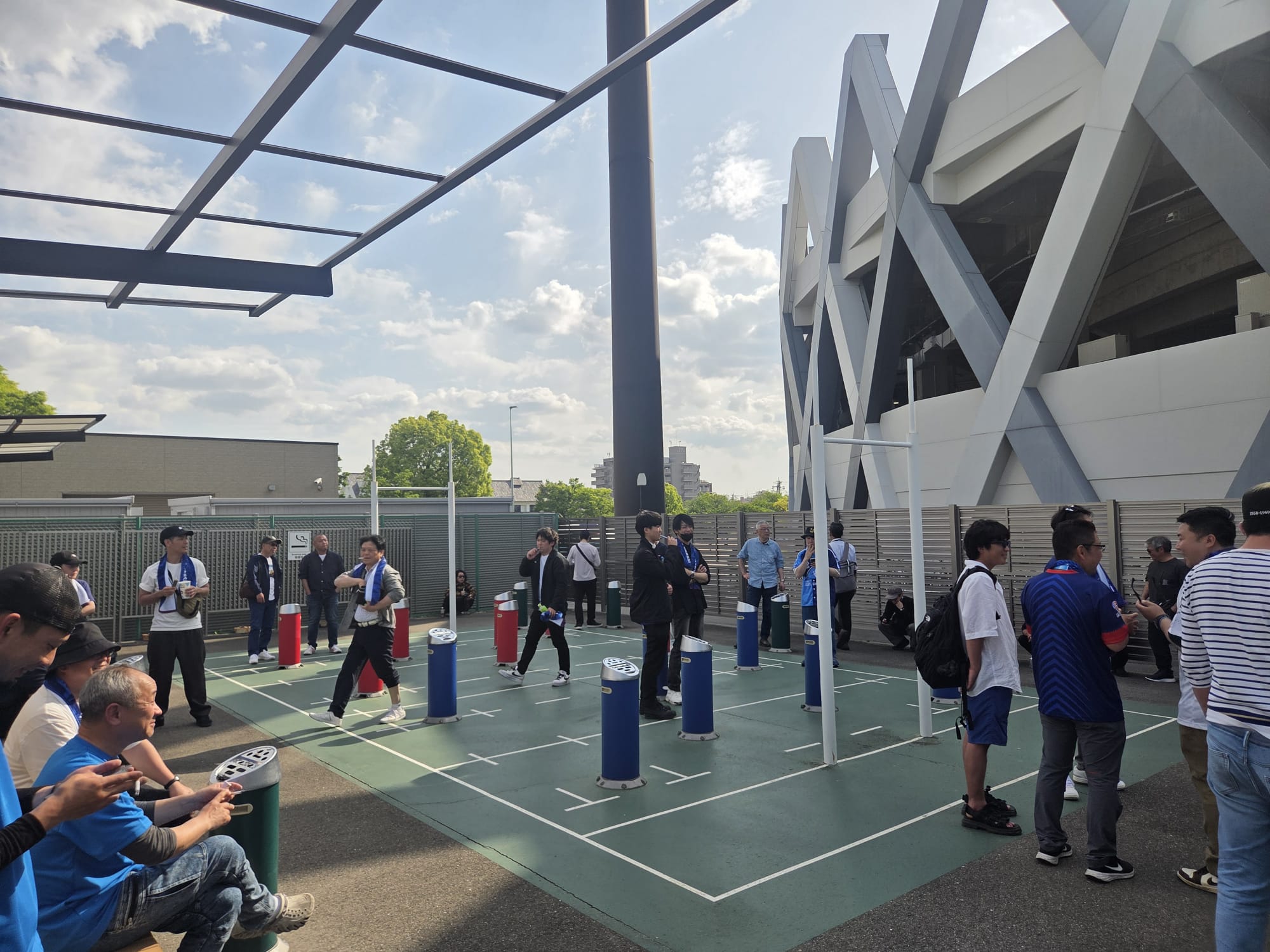
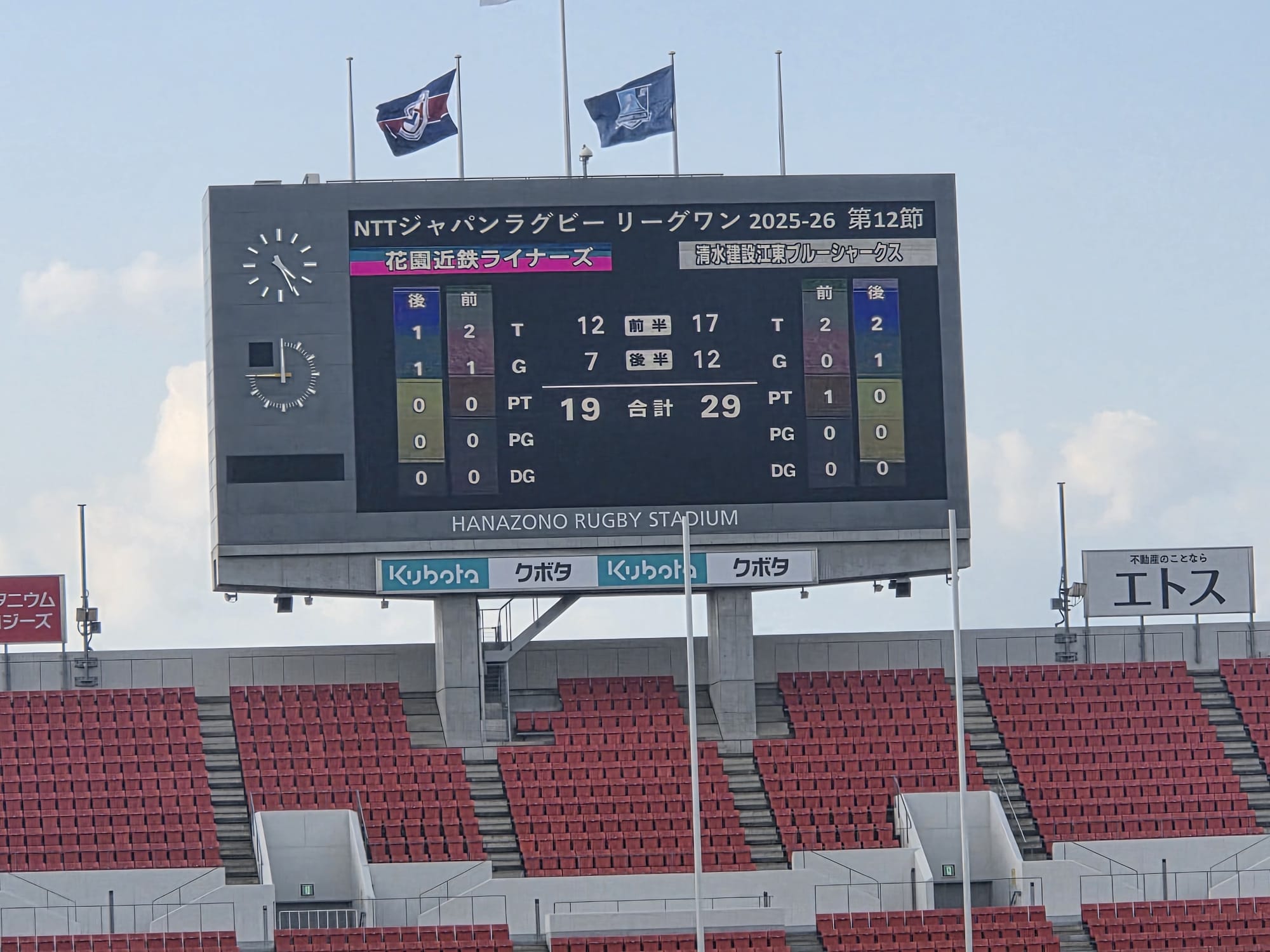
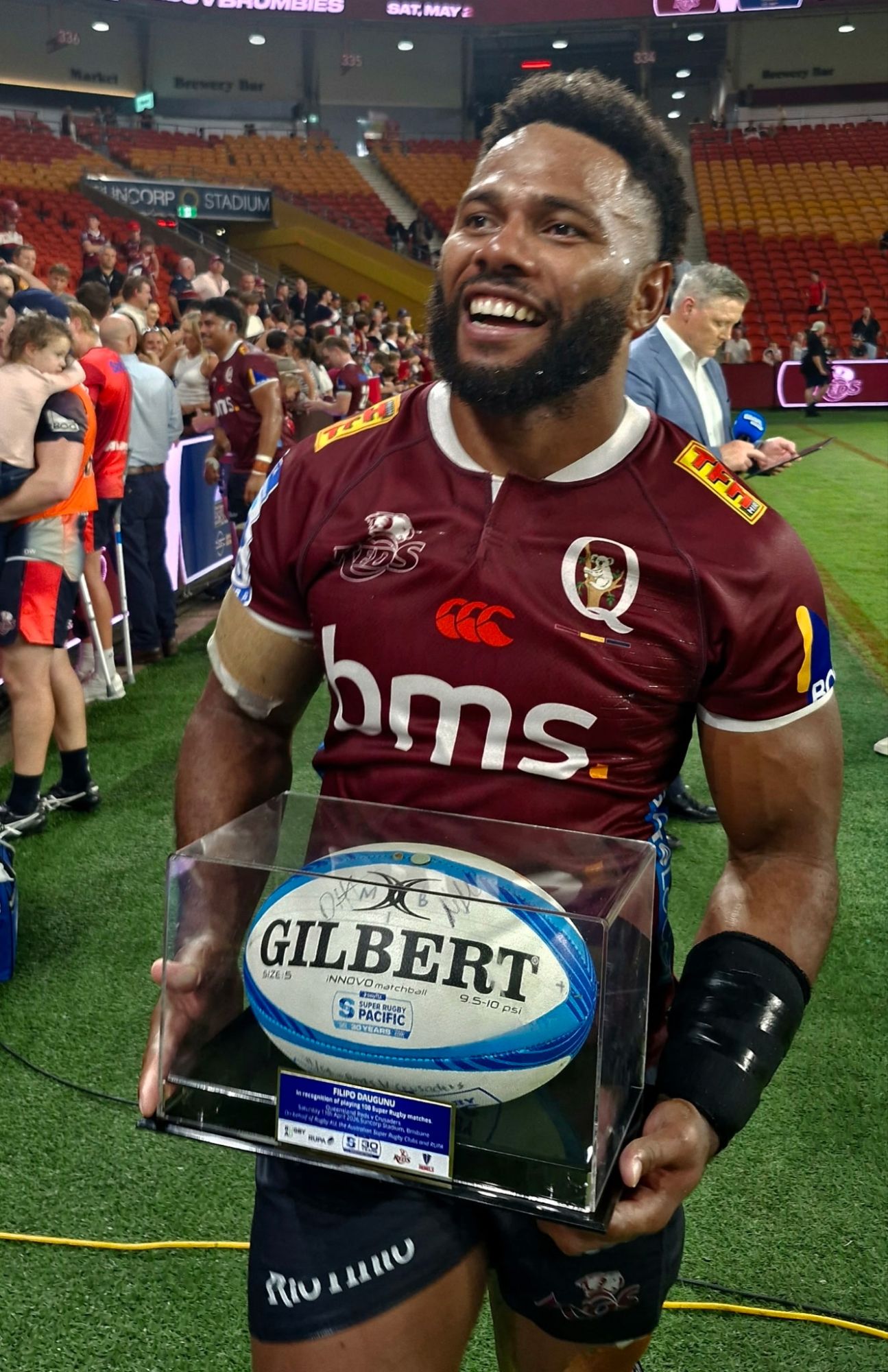

 Brisbane Rugby.com